What Is Hyakki Yagyo? Japan's Night Parade of One Hundred Demons, Explained
What is hyakki yagyo? A folklore-and-culture explanation of Japan's night parade of demons — the tales in Konjaku Monogatari and Uji Shui Monogatari, the Muromachi picture scrolls, the link to tsukumogami, and what was said to happen if you met it. Lore only.
By Katsuki Mitsumori
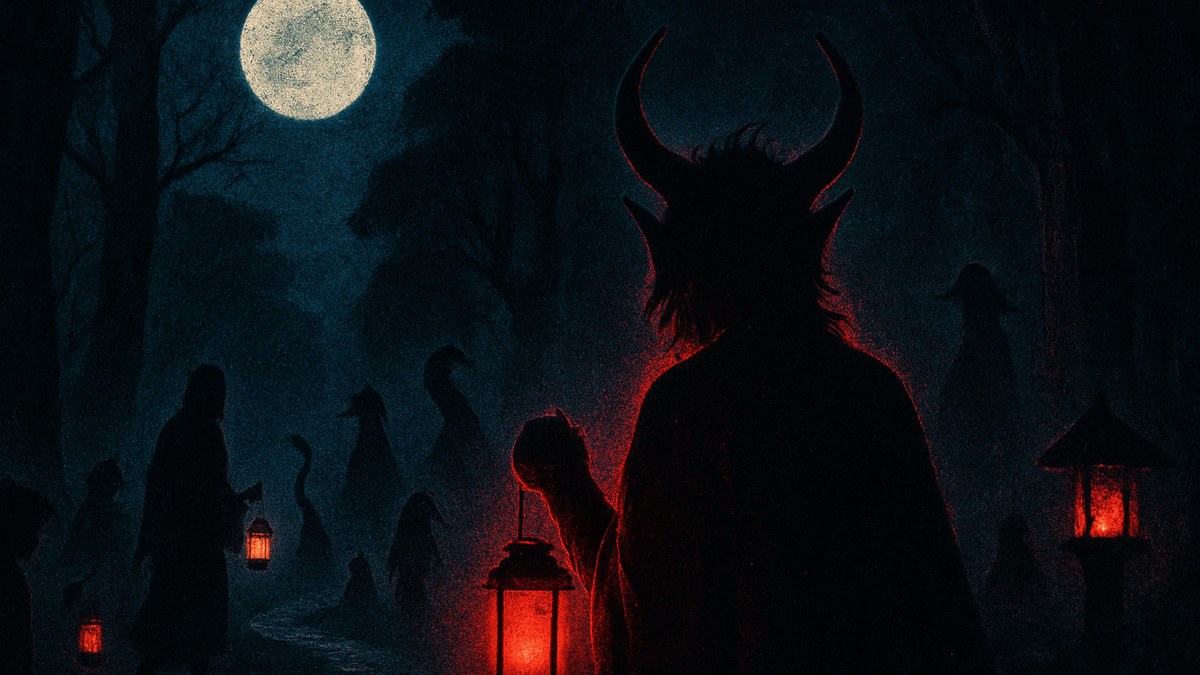
Down the great avenue at midnight, a procession of demons and yokai shuffles past. Hyakki yagyo — the night parade of one hundred demons — is the single image that best captures how Japan imagined the uncanny. Even now, a room where everyone is doing exactly as they please gets called "a regular hyakki yagyo."
This article explains what hyakki yagyo is, where the name comes from, how it grew from Heian tales into Muromachi scrolls, and what was said to happen if you met it — purely as a matter of folklore and culture.
What hyakki yagyo is (the meaning)
Hyakki yagyo, also read hyakki yako, is the tradition of a great many demons and yokai marching in procession through the streets late at night. The "hundred" is not a number but an idiom for "countless." The phrase points at a scene: uncountable strange shapes on the move, after dark.
By extension it survives in modern Japanese as a set phrase for any chaotic scene in which a crowd behaves however it likes.
The parade in the tales — Konjaku and Uji Shui
Hyakki yagyo appears repeatedly in the tale collections of the Heian and Kamakura periods. Konjaku Monogatarishu and Uji Shui Monogatari both preserve stories of nobles and officials who blundered into the procession on a night road.
What the stories share is that meeting it does not end well. The victim dies, loses their mind, or loses part of their body. The ones who survive do so because of a charm: a Sonsho Dharani sewn into their robe by a mother, or some other protective gofu or scripture.
There was also a tradition of fixed "hyakki yagyo nights" listed in the calendar, on which one simply stayed indoors. Like the warning not to be out at omagatoki, it was a way of managing the dangers of the dark through almanac and story.
The scrolls and the tsukumogami — when tools start walking
From the Muromachi period on, hyakki yagyo flowered as a subject for painting. The scroll at Shinju-an in Daitoku-ji is the most famous, and what marches in it is not only horned demons. Biwa lutes, kotos, pots, kettles, umbrellas and straw sandals — worn-out household tools that have grown faces and limbs and are visibly enjoying themselves.
That connects straight to the idea of tsukumogami: objects that pass long years acquire a spirit, and if they are thrown out carelessly they turn yokai and come back to startle you. The procession can be read as the tools flung out at the year-end cleaning, banding together for a march.
What is striking in Japanese yokai painting is that the mood is less horror than festival. Feared, yet somehow cherished. That distance became the foundation of everything that came after in Japanese monster culture.
Why it had to be a crowd
Hyakki yagyo endured, arguably, because it was a crowd. A single onryo or akuryo has a name and a history, and can be pacified by enshrining it. The night parade has neither name nor origin. It simply arrives, in numbers.
A vague dread of the dark; an accumulation of unaccountable presences in a growing city. Things that could not be named one by one were gathered by Japanese tradition into a single phrase.
The modern night parade — naming the nameless
Plenty arrives at us unnamed too. Piled-up notifications, deadlines, one remark someone made, a general sense of not being at ease. Each is small, but arriving together at night they become exactly a procession: unmanageable.
Older generations called it hyakki yagyo, painted it, and gave it a name. Naming is also the work of shrinking a fear to a size you can handle — turning something formless into something with an outline. That remains an effective move.
Break the parade apart by writing it down
You lie down to sleep and the whole day's unpleasantness arrives at once and will not leave your head. When that happens, set the procession down on paper one figure at a time. Written out, anxieties that had blurred into each other recover their separate outlines — and you usually find there are fewer of them than it felt like.
Noroi Nikki is a private app for writing out exactly those negative feelings you cannot say to anyone, and quietly setting them down. Saved journal text is not public to other users. You choose whether to share a curse card. Before the parade swallows you, name them one by one and get them outside.
For more folklore of the night, see what tsukumogami are and what time ushimitsudoki is.
FAQ
Frequently asked questions
Q.What does hyakki yagyo mean?
Hyakki yagyo (also read hyakki yako) is the legend of a great procession of demons and yokai marching through the streets in the dead of night. The 'hundred' is not a count but a way of saying 'a great many.' By extension the phrase is used for any scene of a crowd running riot.
Q.What was said to happen if you met the parade?
In Heian-period tales, anyone who ran into the procession lost their life or their mind; only those carrying the Sonsho Dharani charm were said to survive. There was also a tradition of fixed 'hyakki yagyo nights' on which the parade appeared. All of this is legend, and nothing has been established as fact.
Q.What are the hyakki yagyo picture scrolls?
They are the family of scrolls painted from the Muromachi period onward that take the yokai procession as their subject. The best known is held at Shinju-an in Daitoku-ji, and it shows biwa lutes, pots, kettles and umbrellas that have sprouted limbs and joined the march — a direct link to the tsukumogami idea that discarded tools become yokai.
About the author
Katsuki Mitsumori三森 捷暉
CEO, SURISUTA K.K. / Operator of Doya Marke AI
Runs Doya Marke AI, a suite of practical AI services spanning content, ads, sales and HR, and hosts the YouTube channel 'SaaS wa Shinimasshen.' Creator and developer of Noroi Nikki, an app for writing out and letting go of emotions.
This article explains folklore, language and culture. It is not medical, legal or religious advice. Traditions are introduced as culture, not as instructions to harm anyone. Claims without a source are marked as popular belief.
RELATED
Related reads
 Folklore of curses
What Are Tsukumogami? Japan's Spirits of Old Objects, Explained
What are tsukumogami? A folklore-and-culture explanation of the Japanese belief that tools and objects gain a spirit after long years — the Tsukumogami Emaki scroll, the link to hyakki yagyo, and the memorial rites for needles and dolls. Lore only.
 Folklore of curses
What Is a Zashiki-warashi? Meaning, Lore, and Tono Monogatari
What is a zashiki-warashi? A folklore-and-culture deep dive into its meaning and the lore of northeastern Japan — the record in Kunio Yanagita's Tono Monogatari, the child-shaped being that brings a household wealth, the tradition that a house declines once it leaves, and the theories about its true nature. Not a claim that it is real.
 Folklore of curses
What Is Kamikakushi? Japan's 'Spirited Away' Tradition, Explained
What is kamikakushi, being "spirited away"? A folklore-and-culture explanation of the Japanese tradition that explains sudden disappearances as the work of tengu, mountain gods or foxes — the Tono Monogatari accounts, the hidden-village stories, and a modern reading. Lore only.