What Is Omagatoki? Japan's Other Witching Hour at Dusk, Explained
What is omagatoki, and what time is it? A folklore-and-culture explanation of Japan's dusk "hour of meeting spirits" — the alternate writing "omagatoki, the hour of great calamity," its link to tasokare (twilight), and how it differs from ushimitsudoki. Lore only.
By Katsuki Mitsumori
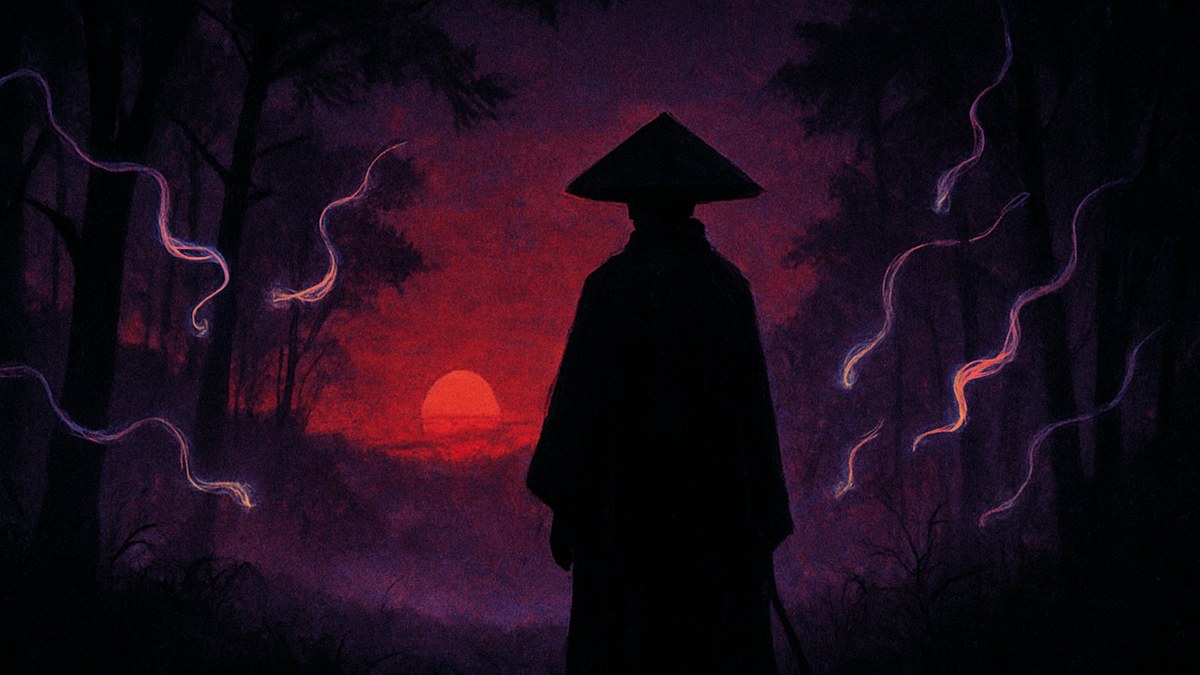
Evening comes, the sky is still faintly bright, and yet you can no longer make out the face of the person walking toward you. In Japan that stretch of the day has a name: omagatoki — the hour of meeting spirits. As the ominous characters suggest, it has long been spoken of alongside the uncanny.
This article explains what omagatoki is: what time it means, where it comes from, how it relates to the writings omagatoki ("great calamity") and tasokare ("who goes there"), and how it differs from ushimitsudoki — purely as a matter of folklore and culture.
What time omagatoki is (the meaning)
Omagatoki is the name for dusk: the sun sinking, a faint light still left in the sky, roughly 5 to 7 p.m. In the old system of hours it falls in the hour of the Rooster. Because sunset shifts with the season, no exact clock time was ever fixed to it. The word points instead at a short band of half-light — the moment day ends and before night has properly begun.
"The hour of great calamity" — the other way of writing it
Omagatoki can also be written with characters meaning "the hour of great calamity" — an hour when misfortune comes easily. Written one way it is the hour you meet a spirit; written the other it is the hour you meet a disaster. Both spell out the same unease from a different angle.
Once the sun goes down, people head home and fieldwork and shops close for the day. In an age with little artificial light, this was genuinely the time you were most likely to lose your footing, take a wrong turn, or walk into someone. Folklore is very often built on top of that kind of lived, practical experience.
Tasokare — the hour when faces stop being legible
The Japanese word for twilight, tasokare, is said to come from the question ta so kare — "who is that over there?" In the half-light you cannot tell whether the figure approaching is an acquaintance, a stranger, or even a person at all. That uncertainty became the name of the hour itself.
Its counterpart is kawataredoki, the faint light before dawn, likewise named for the question "who is that?" Daybreak and nightfall are both moments when light and dark trade places, and Japanese tradition found a particular disquiet in them.
Why the in-between hours were feared
Behind the special treatment of omagatoki lies a dread of boundaries. In Japanese folklore, wherever two domains touch — day and night, this world and the next, village and mountain — things not of the ordinary world were thought to pass back and forth. The foot of a bridge, a crossroads, a mountain pass, and dusk: all of them are "in between," and all of them called for care.
"Come home before dark" reads today as sensible advice about a child's safety. Older generations passed on the same wisdom in the shape of a story about meeting spirits. Legends of the uncanny have very often worked as safety devices for everyday life.
How it differs from ushimitsudoki
Compared with ushimitsudoki, the other famous hour of the uncanny, the quality of the fear is different. Ushimitsudoki is around 2 a.m., when darkness and silence reach their maximum, and its depth is what frightens. Omagatoki unsettles instead through ambiguity: light still remains, and yet nothing can be made out clearly.
Where ushimitsudoki became tied to an active ritual such as ushi no koku mairi, omagatoki was spoken of as a passive warning — don't go out. Even within the uncanny, there is a difference between walking into the dark and staying clear of it.
Feeling low at dusk is real — a modern view
Set the supernatural aside and there are still reasons the evening leaves people uneasy. The stretch when brightness falls away toward sunset is when the body clock switches from day to night. Tiredness and worry that daytime activity kept at bay surface the moment your hands are free — "I suddenly get low in the evening" is something a great many people recognise.
At the end of the day, everything that went wrong, everything left unsaid, every unresolved grudge arrives at once. When older generations sensed something otherworldly at dusk, they may simply have been giving that movement of the heart a story to live in.
Write out the dusk unease before the night sets in
Omagatoki was feared because, on the border between light and dark, the human heart sways easily toward uncertainty. Come evening, the irritation and regret stored up over the day take on a shape and press in. Almost everyone knows that feeling.
But there is no need to carry it through to the next morning. Feelings that swell inside your head grow far lighter once they are put into words and let out. Noroi Nikki is a private app for writing out exactly those negative feelings you cannot say to anyone, and quietly setting them down. Saved journal text is not public to other users. You choose whether to share a curse card.
Rather than holding it alone through the in-between hour, write it into a journal and get it off your chest before the night arrives.
For more legends about the hours of the day, see what time ushimitsudoki is and what tatari means.
FAQ
Frequently asked questions
Q.What time is omagatoki?
Omagatoki is the name for dusk — the stretch when the sun has begun to set but the sky is still faintly light, roughly 5 to 7 p.m. It corresponds to the old hour of the rooster (about 5 to 7 p.m.), and has long been treated as a special, in-between time that is neither day nor night.
Q.Why was omagatoki considered ominous?
In the half-light it becomes hard to make out a person's face or figure, so you cannot quite tell whether what stands before you is human or not. That unease is thought to have produced the legend of an 'hour when you meet spirits.' It is also written as 'omagatoki, the hour of great calamity,' an hour when misfortune was said to come easily. This is folklore, and nothing has been shown actually to occur then.
Q.How is omagatoki different from ushimitsudoki?
Omagatoki is the faint light of dusk; ushimitsudoki is the pitch dark of around 2 a.m. Both are called hours of the uncanny, but omagatoki unsettles through the ambiguity of the border between day and night, while ushimitsudoki frightens because darkness and silence reach their peak. The quality of the fear is different.
About the author
Katsuki Mitsumori三森 捷暉
CEO, SURISUTA K.K. / Operator of Doya Marke AI
Runs Doya Marke AI, a suite of practical AI services spanning content, ads, sales and HR, and hosts the YouTube channel 'SaaS wa Shinimasshen.' Creator and developer of Noroi Nikki, an app for writing out and letting go of emotions.
This article explains folklore, language and culture. It is not medical, legal or religious advice. Traditions are introduced as culture, not as instructions to harm anyone. Claims without a source are marked as popular belief.
RELATED
Related reads
 Folklore of curses
What Is Ushimitsudoki? What Time Is the Japanese Witching Hour? Meaning and Origins
What is ushimitsudoki, and what time is it? A folklore-and-culture explanation of Japan's "witching hour" — the name for around 2 a.m., its link to the phrase "when even the grass and trees sleep," and its connection to the ushi no koku mairi ritual. Lore only.
 Folklore of curses
What Is Kamikakushi? Japan's 'Spirited Away' Tradition, Explained
What is kamikakushi, being "spirited away"? A folklore-and-culture explanation of the Japanese tradition that explains sudden disappearances as the work of tengu, mountain gods or foxes — the Tono Monogatari accounts, the hidden-village stories, and a modern reading. Lore only.
 Folklore of curses
Types of Curses in Japan: A Folklore Guide to Japanese Curses
What are the types of curses in Japanese folklore? A clear guide from folklore and legend — the sympathetic and contagious principles behind all magic, curses using tools like straw dolls, curses of words and kotodama, curses of spirits such as ikiryo and onryo, and kodoku and possession-lineage lore. Not a how-to for cursing anyone.