What Is Ushi no Koku Mairi? The Meaning and Origins of Japan's Midnight Curse Ritual
What is ushi no koku mairi (the hour-of-the-ox shrine visit)? A folklore-and-culture explanation of its meaning and origins — the ritual of nailing a straw doll at the witching hour, and the legend of the "curse rebound." Not a how-to, and not something we encourage doing.
By Katsuki Mitsumori
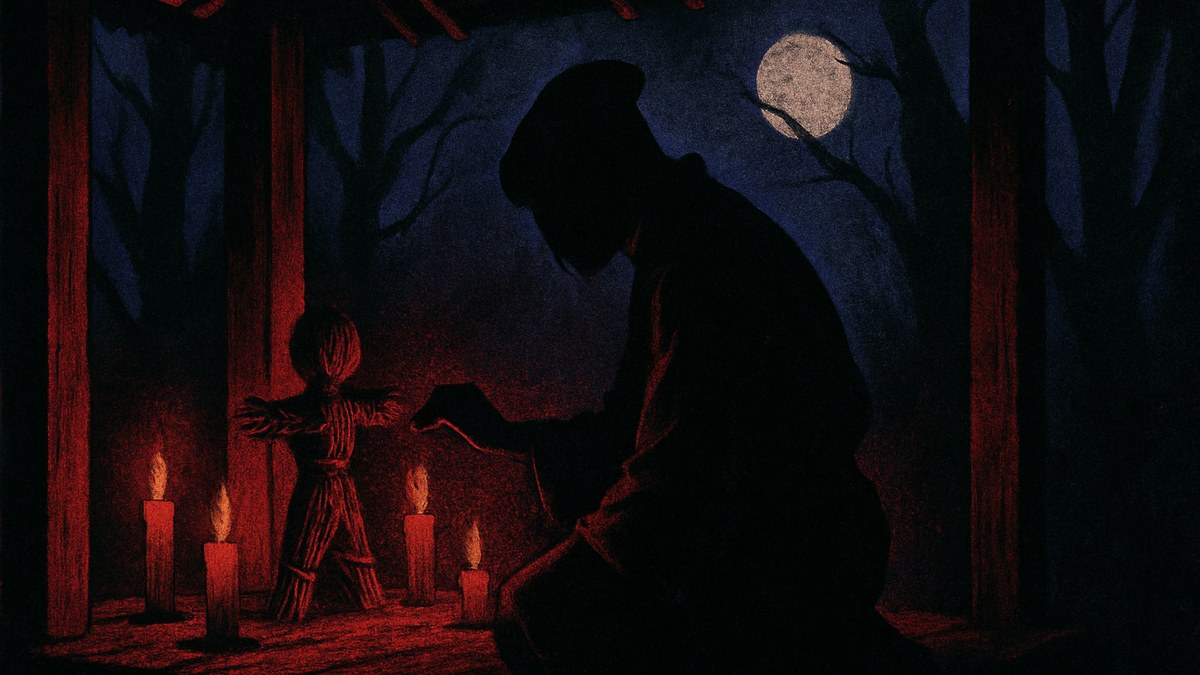
You may have heard the phrase "ushi no koku mairi" at least once, in a ghost story or a TV drama. A figure robed in white, driving nails into a straw doll at a shrine deep in the night — that shadowy image tends to take on a life of its own. Yet behind it lies more than a thousand years of Japanese belief and folklore.
This article aims to be the most careful single explanation you can read of what ushi no koku mairi is — its meaning and origins, the lore around how it was performed, and how it is regarded today — purely as a matter of folklore and culture. It is not a guide to cursing anyone. At the end, we also touch on how to face feelings of resentment and the urge to curse.
What ushi no koku mairi means (and how to read it)
Ushi no koku mairi is a Japanese folk legend of a magical ritual: during the hour of the ox — roughly 1 to 3 a.m. — a person visits a shrine and nails a straw doll representing a hated person to a sacred tree, seeking to bring a curse upon them. It is also called ushi no toki mairi, ushi mairi, or ushimitsu mairi. It was believed that if one made the visit for seven consecutive nights, the seventh completed the vow and the target would die — but that if anyone saw the act, its power was lost. It bears repeating: this is folklore only, and no effect on anyone has ever been verified.
When is "the hour of the ox"? Ushimitsudoki and the far shore
"The hour of the ox" is a way of telling time by the twelve zodiac animals, corresponding to roughly 1 to 3 a.m. Its latter half, around 2:00 to 2:30 a.m., is called ushimitsudoki — the darkest hour of the night, when the boundary between this world and the next (tokoyo) was thought to grow thin. In onmyodo, this hour was held to be a time when one could easily commune with spirits and the otherworld, and visiting a shrine to pray in seclusion deep in the night was not originally tied to cursing at all — it was a form of faith. For more on the hour itself, see what ushimitsudoki is.
From prayer to curse: origins and history
In fact, the older word is ushi no toki mairi, which originally meant simply visiting a shrine during the hour of the ox to have a wish fulfilled. Only later did it turn into an act of cursing (juso). Kifune Shrine in Kyoto carries a tradition that a wish made in "the hour of the ox, on the day of the ox, in the month of the ox, in the year of the ox" would come true, and such lore became entwined with curse stories. Cursing by driving nails into an effigy is itself ancient: the Nihon Shoki records a curse using a human figure, and a wooden effigy (hitogata) with an iron nail driven into its chest has been excavated from a Nara-period site.
The Bridge Princess and the Noh play "Kanawa": a stylized image
The prototype of the white-robed, iron-crowned figure known today is said to be the legend of the Bridge Princess of Uji. A woman driven mad by jealousy wished to become a demon, and following an oracle of the Kifune deity, she set an iron trivet (kanawa) upon her head, lit fires on it, and immersed herself in the Uji River. This story was taken into the Muromachi-period Noh play "Kanawa," stylized as a demoness in red robes with her face painted vermilion. Much of the performer's image in the legend — white robes, disheveled hair, a trivet of candles on the head, a mirror hung at the chest, a straw doll struck with a five-sun nail — was likewise shaped through such theatre and spread in the Edo period. Folk beliefs also survive that hiding the target's hair or nails in the doll strengthens the effect, or that where you strike decides where harm befalls them — but none of these is a grounded "procedure."
The "curse rebound" lore
This ritual is always shadowed by the lore that "if seen by others, its power vanishes" and that "the curse instead rebounds onto you." The condition of acting unseen heightens the tension of a hidden deed and also mirrors the figure of someone bearing alone a violent feeling they can tell no one. Beneath this lore runs a sense of admonition — that cursing carries a fitting recompense. On the rebound itself, see also what noroi-gaeshi is.
Common misconceptions and how it is regarded today
The idea that "doing ushi no koku mairi truly lets you curse someone" is a misconception. No effect has been scientifically verified; if anything, believing oneself cursed can act as self-suggestion and invite real distress. And today, driving nails into a shrine's sacred tree without permission can constitute criminal trespass or property damage. Ushi no koku mairi is not a spell to perform, but folklore to appreciate — a mirror of how the Japanese have faced the heart that comes to hate another deeply.
Let the feeling out in words, not in action
As a legend, ushi no koku mairi shows us how deep human hatred can run, and how far back it has driven people. But there is no need to hurl that violent feeling into real action. Anger fierce enough to make you want to curse someone becomes far lighter once you first put it into words and get it out of yourself.
Saved journal text in Noroi Nikki is not public to other users. Rather than carrying it alone deep in the night, write that resentment into a journal and set it down from your chest, little by little.
For a related piece of lore, see also the meaning of the straw-doll curse.
FAQ
Frequently asked questions
Q.What does ushi no koku mairi mean?
It is a Japanese folk legend of a magical ritual in which a person visits a shrine during the hour of the ox (roughly 1 to 3 a.m., especially the midpoint known as ushimitsudoki), and nails a straw doll representing a hated person to a sacred tree to bring a curse upon them. Also called ushi no toki mairi, it was said that the wish would be granted if performed unseen for a set number of nights. This is folklore only, with no proven effect on anyone.
Q.How old is ushi no koku mairi?
Its exact origin is unclear, but it is said to trace back to Heian-period lore. It has been passed down in connection with the Noh and kabuki play Kanawa and the legend of the Bridge Princess of Uji, and the form known today is thought to have spread in the Edo period.
Q.Is it true that being seen causes the curse to rebound?
This is one of the legends attached to the ritual — that being seen by others cancels its power, or that the curse rebounds onto the person casting it (a curse rebound). It has no scientific basis and is best understood purely as folklore.
About the author
Katsuki Mitsumori三森 捷暉
CEO, SURISUTA K.K. / Operator of Doya Marke AI
Runs Doya Marke AI, a suite of practical AI services spanning content, ads, sales and HR, and hosts the YouTube channel 'SaaS wa Shinimasshen.' Creator and developer of Noroi Nikki, an app for writing out and letting go of emotions.
This article explains folklore, language and culture. It is not medical, legal or religious advice. Traditions are introduced as culture, not as instructions to harm anyone. Claims without a source are marked as popular belief.
RELATED
Related reads
 Folklore of curses
What Is Noroi-gaeshi? The Meaning of Japan's 'Curse Rebound' Folklore
What is noroi-gaeshi (the curse rebound)? A folklore-and-culture explanation of its meaning, the ushi no koku mairi legend that "if you're seen, it returns to you," and why it has long been feared. Not a how-to, and not something we encourage doing.
 Folklore of curses
Types of Curses in Japan: A Folklore Guide to Japanese Curses
What are the types of curses in Japanese folklore? A clear guide from folklore and legend — the sympathetic and contagious principles behind all magic, curses using tools like straw dolls, curses of words and kotodama, curses of spirits such as ikiryo and onryo, and kodoku and possession-lineage lore. Not a how-to for cursing anyone.
 Folklore of curses
What Does the Straw Doll Curse Mean? The Folklore Behind Japan's Wara Ningyo
What does the straw doll curse (wara ningyo) mean? A folklore-and-culture explanation of the five-inch-nail legend, its link to the midnight shrine ritual, and the idea of the "effigy." Not a how-to, and not something we encourage doing.