What Is Noroi-gaeshi? The Meaning of Japan's 'Curse Rebound' Folklore
What is noroi-gaeshi (the curse rebound)? A folklore-and-culture explanation of its meaning, the ushi no koku mairi legend that "if you're seen, it returns to you," and why it has long been feared. Not a how-to, and not something we encourage doing.
By Katsuki Mitsumori

Many people have heard the Japanese proverb "curse someone, and you dig two graves." Curse another, and the payback eventually comes back to you as well — at the heart of this idea sits the folk belief of noroi-gaeshi, the "curse rebound."
This article explains what noroi-gaeshi is — its meaning and background — tracing back through the history of onmyodo and the folk customs meant to protect oneself, purely as a matter of folklore and culture. It does not encourage working any magic. At the end, we also touch on how to face feelings of resentment and the urge to curse.
What noroi-gaeshi means
Noroi-gaeshi is a folk belief that a curse cast on someone, or one cast upon you, bounces back to its sender. The idea is that misfortune returns to the very person who worked the magic, and it appears in folk beliefs and stories across Japan. It is also called juso-gaeshi, and traditions sometimes describe rites for sending a received curse straight back — and it was said that the returned curse struck the original sender many times over. Of course, this is folklore, and no such phenomenon has ever been verified. For the meaning of the curse itself, see also what juso is.
"Curse someone, and you dig two graves" — the idea of retribution
Beneath noroi-gaeshi lies the idea of cause and effect, captured in the proverb "curse someone, and you dig two graves." It means that if you dig a grave to bury the person you curse, you will in time need a grave of your own too — a warning that any act meant to harm another eventually returns to you. The sense that a fierce act like cursing carries a matching risk has been handed down since ancient times in the form of stories and folk belief.
Onmyodo and the sending-back of curses: rebound in history
The idea of the curse rebound was not confined to popular folk belief. In the Heian-period court, the onmyoji (masters of onmyodo) are said to have performed juso-gaeshi — turning back a curse cast by another — and chobuku, the subduing of forces that brought calamity. In that aristocratic society, curses from political rivals were feared in earnest, and as the counter-craft of specialists, the curse rebound held a place close to an institution. Where a technique for cursing people is believed to exist, a technique for turning it back is demanded as well — curse and curse-rebound were, in a sense, two sides of one coin. For the role of the onmyoji, see what an onmyoji is.
Ushi no koku mairi and the curse-rebound lore
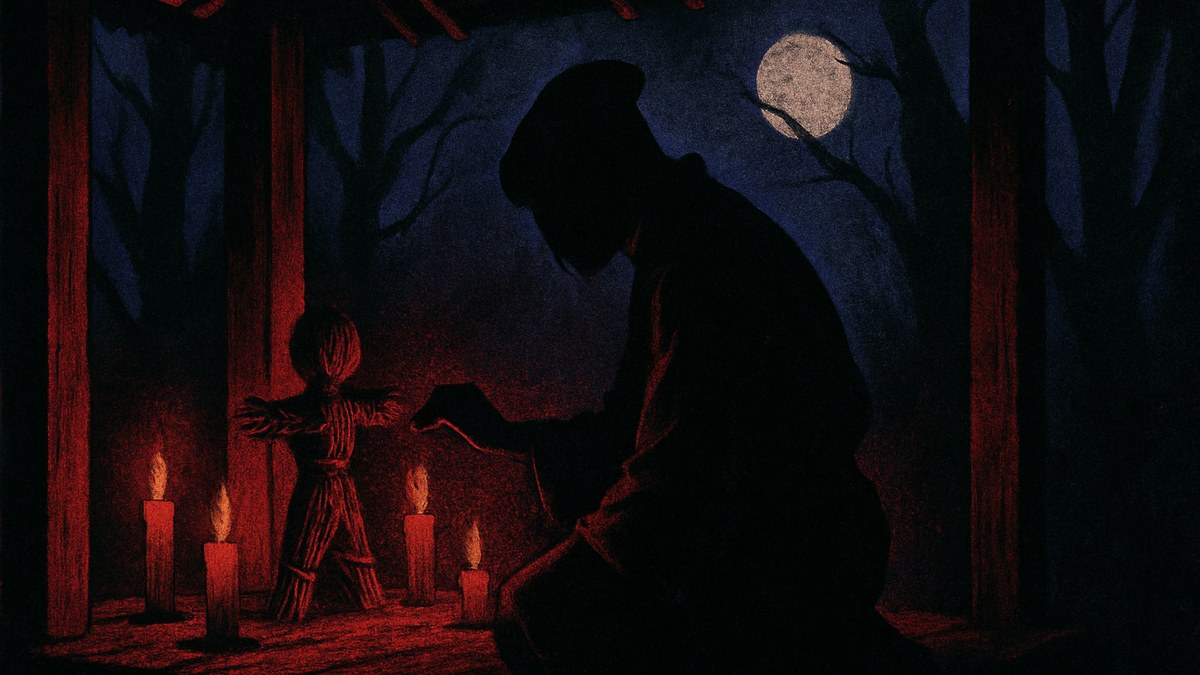
The best-known example of noroi-gaeshi is the ushi no koku mairi legend. This ritual of driving nails into a straw doll at a shrine deep in the night carries the conditions that "if others see you, the power vanishes" and that "instead the curse returns to you." The tension of having to act unseen, and the dread that if you are seen, misfortune rebounds onto your own body. Noroi-gaeshi has been told as a shadow that forever trails anyone who attempts a curse.
The curse rebound in the Noh play "Kanawa"
The curse rebound is vividly depicted in classical theatre as well. In the Noh play "Kanawa," a man tormented by the resentment of the wife he abandoned visits the onmyoji Abe no Seimei. Seimei prepares nademono effigies shaped after the couple, performs prayers, and repels the woman's vengeful living spirit — now turned demon — with the power of the gods. A curse seeking to vent its resentment is turned back by the power of prayer; this story is a prime example, carried down to today, of the very scene where curse and curse-rebound clash.
The folk customs said to turn a curse away
Folk customs for turning back misfortune, or keeping it away, have also been handed down across Japan. Setting out a cone of salt at the entrance (morijio), wearing a protective talisman or amulet, scattering salt, or breathing out to purify — these are the best-known examples. They are not techniques for harming others, but folk wisdom passed down purely to "protect oneself." Their effect has never been scientifically verified, yet as small rituals that soothe an anxious heart, they surely carried meaning. For talismans and amulets, see also what a gofu is.
Write resentment out and let it go, before sending it back
What the noroi-gaeshi legend may teach us is a sense that "the act of hurling resentment at another comes around, in the end, to bind you yourself." In fact, while you go on cursing someone, the one touching that feeling the longest is none other than you.
Noroi Nikki is a private app for gently writing out, and letting go of, that resentment before you send it back to anyone. Saved journal text is not public to other users. Step back from a relationship of trading curses, and first let the resentment pooled in your chest out into a place that is yours alone. The more you let it out, the lighter that weight becomes, little by little.
For the lore of the curse itself, see also what ushi no koku mairi is.
FAQ
Frequently asked questions
Q.What does noroi-gaeshi mean?
Noroi-gaeshi (the curse rebound) is a folk belief that a curse you cast on someone, or one cast upon you, bounces back to its sender. The idea is that misfortune returns to the person who worked the magic; it appears in folk beliefs and stories across Japan. It is tradition only, and no such phenomenon has ever been verified.
Q.Why is it said that a curse returns to you?
The background is said to be a warning against cursing, and the idea of cause and effect (karmic retribution). The ushi no koku mairi legend — 'if others see you, the power vanishes and instead returns to you' — is a prime example, passed down in part as a warning that cursing someone carries a matching risk.
Q.Does noroi-gaeshi actually work?
Noroi-gaeshi is folklore, not something with any scientifically verified effect. Still, the sense that 'curse someone and it eventually comes back to you' does, in a way, capture the real suffering of staying trapped in resentment.
About the author
Katsuki Mitsumori三森 捷暉
CEO, SURISUTA K.K. / Operator of Doya Marke AI
Runs Doya Marke AI, a suite of practical AI services spanning content, ads, sales and HR, and hosts the YouTube channel 'SaaS wa Shinimasshen.' Creator and developer of Noroi Nikki, an app for writing out and letting go of emotions.
This article explains folklore, language and culture. It is not medical, legal or religious advice. Traditions are introduced as culture, not as instructions to harm anyone. Claims without a source are marked as popular belief.
RELATED
Related reads
 Folklore of curses
What Is Ushi no Koku Mairi? The Meaning and Origins of Japan's Midnight Curse Ritual
What is ushi no koku mairi (the hour-of-the-ox shrine visit)? A folklore-and-culture explanation of its meaning and origins — the ritual of nailing a straw doll at the witching hour, and the legend of the "curse rebound." Not a how-to, and not something we encourage doing.
 Folklore of curses
What Does the Straw Doll Curse Mean? The Folklore Behind Japan's Wara Ningyo
What does the straw doll curse (wara ningyo) mean? A folklore-and-culture explanation of the five-inch-nail legend, its link to the midnight shrine ritual, and the idea of the "effigy." Not a how-to, and not something we encourage doing.
 Folklore of curses
Types of Curses in Japan: A Folklore Guide to Japanese Curses
What are the types of curses in Japanese folklore? A clear guide from folklore and legend — the sympathetic and contagious principles behind all magic, curses using tools like straw dolls, curses of words and kotodama, curses of spirits such as ikiryo and onryo, and kodoku and possession-lineage lore. Not a how-to for cursing anyone.