What the Six Coins Mean — the Toll for the Sanzu River and the Sanada Crest
The six coins are the toll placed with the dead for crossing the Sanzu River. This piece covers why the number is six (one for each of the six realms), the burial custom and its paper form today, and what the Sanada clan meant by putting the coins on their crest.
By Katsuki Mitsumori
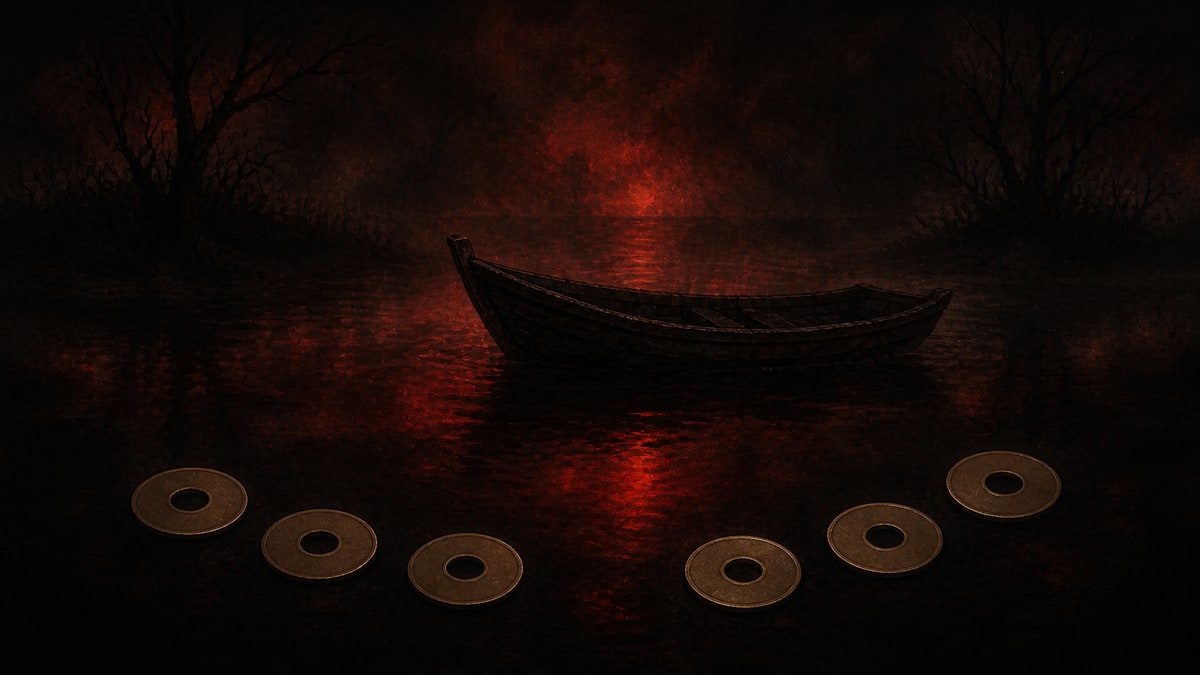
The six coins are known as the toll for the river of the dead. The phrase turns up in period drama and at funerals — but why six, and what actually happens today, are less widely known.
This article traces the meaning of the six coins through the lore of the Sanzu River and the six realms, and on to the Sanada clan crest.
What the six coins mean
Rokumonsen are the six coins placed with the dead as the toll for crossing the Sanzu River. They are also called meisen, spirit money.
The last travelling money you can carry on the road to the next world. Anyone without the toll cannot cross, and is stripped of their robes on the bank by Datsueba — the two traditions are always told together. Whoever is setting out, at least let them carry their fare: the custom holds a very plain wish.
Why six — the six realms
The best-known account pairs the number with the six realms: hell, hungry ghosts, beasts, asura, humans and heaven. One coin for each of the six worlds of rebirth, so that whichever you land in, you are not stranded.
This is one leading explanation rather than a settled origin. Still, there is a plain logic to it: if there are six possible destinations, provide for six. It was one of the few preparations the living could still make while the verdict was pending.
The burial custom, and its form today
Real coins were once placed in the coffin. Because metal interferes with cremation, a printed paper version is now usual; some regions use wooden ones.
Practice also varies by school. Jodo Shinshu, for instance, teaches immediate birth in the Pure Land and does not take the river crossing as a premise, so the coins are customarily not used. Follow local and denominational custom.
The Sanada crest — the mark of those ready to die
Many people know the six coins first as the crest of the Sanada clan. Carried by Sanada Yukimura (Nobushige) and his house, the emblem is said to declare a readiness to cross the river of the dead at any moment — that is, a refusal to fear death.
To carry the toll at all times is to be willing to die at any time. Taking an implement of funeral rites and flying it as a battle standard is one of the more striking gestures in Japanese warrior culture.
The shape of "letting them carry something" — a modern view
Looked at today, the custom turns out to have been less for the dead than for those seeing them off. There is nothing you can do for them, and still you want them to carry something. The six coins gave that feeling somewhere to go.
The same holds for relationships that have ended. Someone you have decided never to see again; time that will not come back. Even knowing there is nothing to be done, you still want your own feeling settled.
To send it off, first write it and close the book
Just as the six coins were an implement for sending someone off, an unsettled feeling needs a procedure for sending off too. Giving it a form before you see it off works far better than trying to force yourself to forget.
Yurusen is a private app for filing that "unforgivable" into a ledger that does not show your entries to other users. You do not need to name anyone. Write what was done and how it felt, and close the book — the way you would hand over a fare and see someone off. It is a private catharsis, never a way to harm a real person.
For more folklore of the next world, see the meaning of the Sanzu River, Datsueba and Sai-no-kawara.
FAQ
Frequently asked questions
Q.What does rokumonsen mean?
Rokumonsen means the six coins placed with the dead as the toll for crossing the Sanzu River. Thought of as the last travelling money that can be carried into the next world, they were once genuinely placed in the coffin. They are also called meisen, spirit money.
Q.Why six?
The best-known explanation pairs them with the six realms — hell, hungry ghosts, beasts, asura, humans and heaven — one coin for each, so that whichever realm you are reborn into, you are not stranded. Other explanations exist; no origin is settled.
Q.Are six coins still placed today?
Metal does not suit cremation, so a printed paper version is now usual. Practice varies by region and funeral company, and some Buddhist schools do not use them at all.
About the author
Katsuki Mitsumori三森 捷暉
CEO, SURISUTA K.K. / Operator of Doya Marke AI
Runs Doya Marke AI, a suite of practical AI services spanning content, ads, sales and HR, and hosts the YouTube channel 'SaaS wa Shinimasshen.' Creator and developer of Yurusen, an app for filing the people you could never forgive into a private ledger of judgment.
RELATED
Related reads
 Enma & Hell
'Heaven's Net Is Wide and Loose, Yet Nothing Slips Through' — Meaning, Origin, and the Wait
The proverb says heaven's net looks coarse-meshed yet never lets a wrongdoer escape. This piece covers its source in the Laozi, how it differs from inga ouhou, and where to put the feeling of waiting for a reckoning that will not come.
 Enma & Hell
What Chikushodo Means — the Realm of Beasts, and the Weight of the Word 'Chikusho'
Chikushodo is the realm of the six where one is born as bird, beast, insect or fish, preying on one another and driven by others. This piece covers how it differs from the hungry-ghost and asura realms, why 'chikusho' became an insult, and what we can still see in it.
 Enma & Hell
What Ashura and the Asura Realm Mean — Endless Conflict and the Origin of 'Shuraba'
Ashura is the fighting deity locked in conflict with Taishakuten. This piece covers what the asura realm is, why winning never ends it, why the Kofuku-ji Ashura statue looks sorrowful, and where the Japanese word shuraba comes from.