What Chikushodo Means — the Realm of Beasts, and the Weight of the Word 'Chikusho'
Chikushodo is the realm of the six where one is born as bird, beast, insect or fish, preying on one another and driven by others. This piece covers how it differs from the hungry-ghost and asura realms, why 'chikusho' became an insult, and what we can still see in it.
By Katsuki Mitsumori
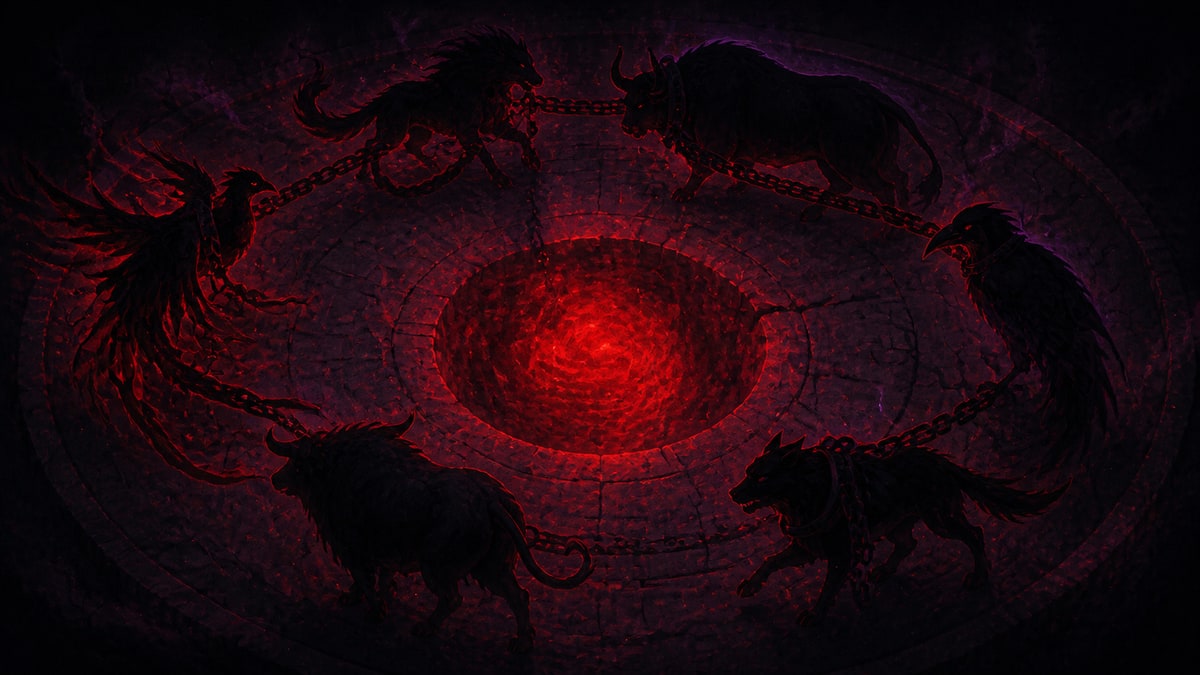
Chikusho! is nowadays a cry of frustration. Originally it was a Buddhist term for chikushodo, one of the six realms.
This article covers what chikushodo means, the particular shape of its suffering, how it differs from the hungry-ghost realm, and why the word became an insult.
What chikushodo means
Chikushodo is the realm of the six in which one is born as bird, beast, insect or fish. Together with hell and the hungry-ghost realm it makes up the "three evil realms" — the destinations nobody wants.
Its suffering is explained as lying in the condition of animal life itself. Creatures prey on one another, live under constant threat, and are driven by humans. Above all, they cannot choose how they live. That, it was said, is the essence of chikushodo.
How it differs from the hungry-ghost and asura realms
All three evil realms are painful, but the pain is of different kinds.
The hungry-ghost realm is where hunger and thirst are never satisfied — food turns to flame at the mouth. The core of it is wanting and never getting.
The suffering of chikushodo is elsewhere. There may be food. But you never know when you will be eaten, and you do not decide where you go. The core is not being able to choose.
The asura realm, meanwhile, is one of unending conflict: the suffering of never being able to stop winning. Set the three side by side and you see how precisely Buddhism sorted human suffering.
Why it was the realm of folly
Falling into chikushodo was often attributed to guchi — not seeing how things actually are. In the three poisons of Buddhism (greed, anger, delusion) it corresponds to delusion; greed is said to lead to the hungry-ghost realm and anger to hell.
The folly meant here is not lack of knowledge. It is the state of being carried along by immediate desire or fear without ever looking at where you are heading. Which is exactly why the realm was drawn as a world where you cannot choose.
How "chikusho" became abuse
Because it was one of the three evil realms and falling into it carried strong shame, the expression "fallen to the beasts" came to be used to condemn behaviour that ignored reason. From there it became a term of abuse, and then a way of venting one's own frustration.
Religious vocabulary turning into swearing happens everywhere, but the interesting part here is that what was being condemned was folly. Not evil as such, but irritation at someone who cannot see the sense of things. Perhaps something of that survives in the modern chikusho!
"Not being able to choose" is still close to home — a modern view
Recast the suffering of chikushodo as "not being able to choose" and it becomes a strikingly modern theme.
A workplace where you can only follow unreasonable orders. A relationship you cannot get out of. A situation where someone else's mood governs your day. All of them place you where your will does not reach — and anger accumulates with nowhere to go.
Even if you cannot change the situation right now, you can keep hold of your own words for what exactly is making you angry. That is the work of retaining your outline instead of being swallowed by the circumstances.
Where you cannot choose, at least keep your words your own
Inside an unreasonable situation, even the feeling starts to seem like it belongs to the other person. Which is why getting your own words back comes first.
Yurusen is a private app for filing that "unforgivable" into a ledger that does not show your entries to other users. You do not need to name anyone. Write what was done and how it felt, and close the book. The situation may be out of your hands; how you record it never is. It is a private catharsis, never a way to harm a real person.
For more on the six realms, see the six realms of rebirth, the hungry-ghost realm and the asura realm.
FAQ
Frequently asked questions
Q.What does chikushodo mean?
Chikushodo is one of the six realms of Buddhism: the world in which one is born as bird, beast, insect or fish. Creatures prey on one another, are driven by humans, and cannot choose how they live. With hell and the hungry-ghost realm it forms the three evil realms.
Q.How does it differ from the hungry-ghost realm?
The hungry-ghost realm is a world where hunger and thirst are never satisfied; the realm of beasts is one of being driven and devoured. The suffering of the former is 'wanting and never getting'; the suffering of the latter is 'not being able to choose.'
Q.Why did 'chikusho' become an insult?
Because chikushodo was one of the three evil realms, falling into it carried strong shame. As the expression 'fallen to the beasts' came to be used to condemn behaviour that ignored reason, it settled into ordinary speech as abuse.
About the author
Katsuki Mitsumori三森 捷暉
CEO, SURISUTA K.K. / Operator of Doya Marke AI
Runs Doya Marke AI, a suite of practical AI services spanning content, ads, sales and HR, and hosts the YouTube channel 'SaaS wa Shinimasshen.' Creator and developer of Yurusen, an app for filing the people you could never forgive into a private ledger of judgment.
RELATED
Related reads
 Enma & Hell
'Heaven's Net Is Wide and Loose, Yet Nothing Slips Through' — Meaning, Origin, and the Wait
The proverb says heaven's net looks coarse-meshed yet never lets a wrongdoer escape. This piece covers its source in the Laozi, how it differs from inga ouhou, and where to put the feeling of waiting for a reckoning that will not come.
 Enma & Hell
What the Six Coins Mean — the Toll for the Sanzu River and the Sanada Crest
The six coins are the toll placed with the dead for crossing the Sanzu River. This piece covers why the number is six (one for each of the six realms), the burial custom and its paper form today, and what the Sanada clan meant by putting the coins on their crest.
 Enma & Hell
What Ashura and the Asura Realm Mean — Endless Conflict and the Origin of 'Shuraba'
Ashura is the fighting deity locked in conflict with Taishakuten. This piece covers what the asura realm is, why winning never ends it, why the Kofuku-ji Ashura statue looks sorrowful, and where the Japanese word shuraba comes from.