What Ashura and the Asura Realm Mean — Endless Conflict and the Origin of 'Shuraba'
Ashura is the fighting deity locked in conflict with Taishakuten. This piece covers what the asura realm is, why winning never ends it, why the Kofuku-ji Ashura statue looks sorrowful, and where the Japanese word shuraba comes from.
By Katsuki Mitsumori
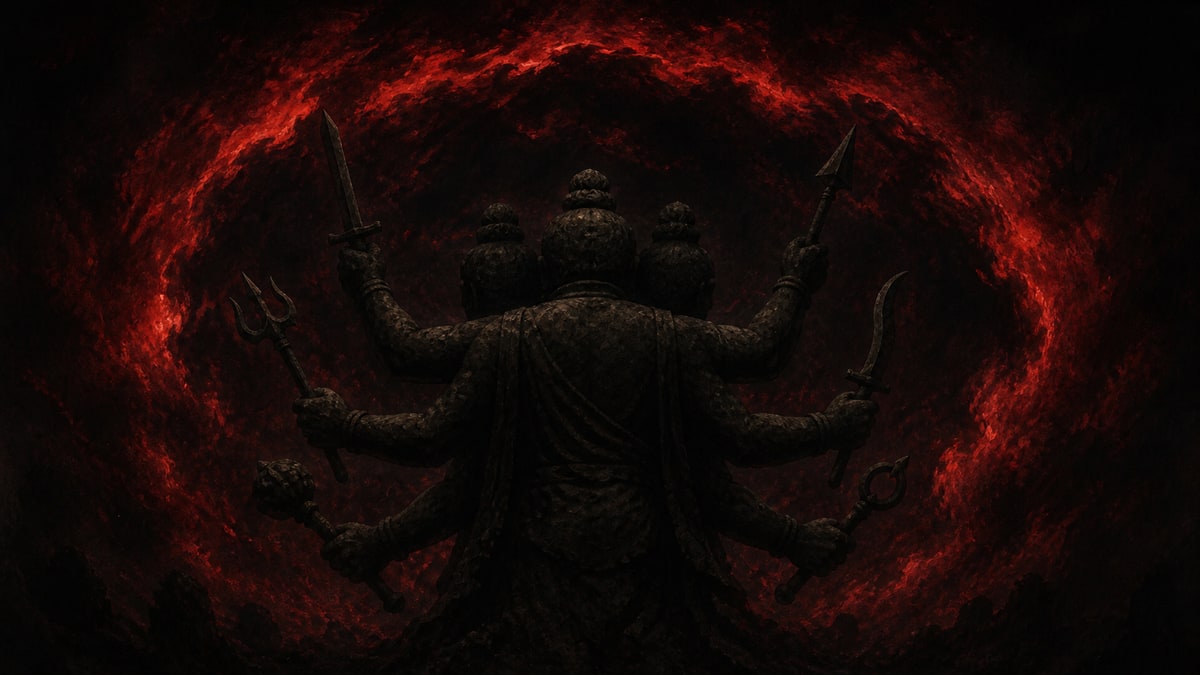
If you have seen the Ashura statue at Kofuku-ji, you will remember the face: a fighting deity with three faces and six arms, and yet the expression is almost boyish, holding more sorrow than rage. That face captures the essence of the asura realm, one of the six realms.
This article covers what Ashura is, what kind of world the asura realm is, and where the Japanese word shuraba comes from.
What Ashura means
Ashura originates in Indian mythology and appears in Buddhism as a fighting deity locked in conflict with Taishakuten (Indra). It is counted among the eight guardian classes of the Buddhist law — not simply a villain.
What defines Ashura is the reason for the conflict. In the tradition it begins when Taishakuten takes Ashura's daughter by force. Ashura, in other words, has a case. Insisting on its own righteousness and unable to stop fighting: that is how the figure is built.
What kind of world the asura realm is
The asura realm sits just above the three evil realms of hell, hungry ghosts and beasts. There is no torment on that scale; there is power, and even abundance. It counts as a realm of suffering anyway, because the fighting never ends.
Win, and the next opponent appears. Lose, and you live for the rematch. Either way, no day arrives on which the mind rests. The suffering of the asura realm is not pain. It is not ending.
Why winning never ends it
Falling into the asura realm is often attributed to man — the habit of measuring yourself against others. As long as your worth is set by comparison, the supply of people to compare against never runs out.
There is a reading on which Ashura cannot beat Taishakuten not for want of strength but by structure: as long as you refuse to step out of the frame of winning and losing, the fight cannot conclude. The sorrow in the statue's face is sometimes read as the face of someone who knows this.
The origin of shuraba
To "go through a shuraba" or for a room to "turn into a shuraba" derives from the battlefield where Ashura and Taishakuten fight — the field of the asura realm. From there it broadened to any scene of violent conflict.
In kabuki and in storytelling, a combat scene itself is called a shuraba. Perhaps that is why the everyday word still carries a faintly theatrical ring.
Stepping out of the fight — a modern view
The logic of the asura realm maps directly onto modern relationships: one-upmanship, arguments online, wars of attrition at work. Each is structured so that winning only produces the next round.
Psychology has established that interpersonal rumination — going over someone in your head again and again — worsens mood and prolongs it. The awkward part is that while you are assembling rebuttals in your head, you are handing that person your hours.
Stepping out of the asura realm is not conceding. It is leaving the arena where winning and losing get decided. Give up changing the other person; take back your own time.
Close the battlefield in your head, at least for now
You cannot step out by ignoring the feeling, though. Deciding "I don't care any more" while still furious usually fails. Something has to be put into words first.
Yurusen is a private app for filing that "unforgivable" into a ledger that does not show your entries to other users. You do not need to name anyone. Write what was done and how it felt, and close the book — leave the battle that was running in your head inside the ledger instead. It is a private catharsis, never a way to harm a real person.
For more on the six realms, see the six realms of rebirth, the realm of beasts and the hungry-ghost realm.
FAQ
Frequently asked questions
Q.What does Ashura mean?
Ashura originates in Indian mythology and appears in Buddhism as a fighting deity locked in endless conflict with Taishakuten. Notably it is not evil as such: it is drawn as a being that insists on its own righteousness and cannot stop fighting.
Q.What kind of world is the asura realm?
One of the six realms, a world of unceasing conflict. It is not as tormented as the three evil realms, but one must fight without end, and even winning brings no rest.
Q.Where does the word shuraba come from?
From the battlefield where Ashura and Taishakuten fight — the field of the asura realm. From there it came to mean any scene of violent conflict or acute tension.
About the author
Katsuki Mitsumori三森 捷暉
CEO, SURISUTA K.K. / Operator of Doya Marke AI
Runs Doya Marke AI, a suite of practical AI services spanning content, ads, sales and HR, and hosts the YouTube channel 'SaaS wa Shinimasshen.' Creator and developer of Yurusen, an app for filing the people you could never forgive into a private ledger of judgment.
RELATED
Related reads
 Enma & Hell
'Heaven's Net Is Wide and Loose, Yet Nothing Slips Through' — Meaning, Origin, and the Wait
The proverb says heaven's net looks coarse-meshed yet never lets a wrongdoer escape. This piece covers its source in the Laozi, how it differs from inga ouhou, and where to put the feeling of waiting for a reckoning that will not come.
 Enma & Hell
What the Six Coins Mean — the Toll for the Sanzu River and the Sanada Crest
The six coins are the toll placed with the dead for crossing the Sanzu River. This piece covers why the number is six (one for each of the six realms), the burial custom and its paper form today, and what the Sanada clan meant by putting the coins on their crest.
 Enma & Hell
What Chikushodo Means — the Realm of Beasts, and the Weight of the Word 'Chikusho'
Chikushodo is the realm of the six where one is born as bird, beast, insect or fish, preying on one another and driven by others. This piece covers how it differs from the hungry-ghost and asura realms, why 'chikusho' became an insult, and what we can still see in it.