What Is Datsueba — The Hag Who Strips Robes at the River of the Dead
Datsueba is the old hag said to strip the robes of the dead at the Sanzu River. This piece traces her origin in the Ten Kings sutra, the robe-weighing tree and her partner Keneo, the river's three crossings, and her Edo-era cult as a cure for coughs, then bridges to the world of Yurusen.
By Katsuki Mitsumori
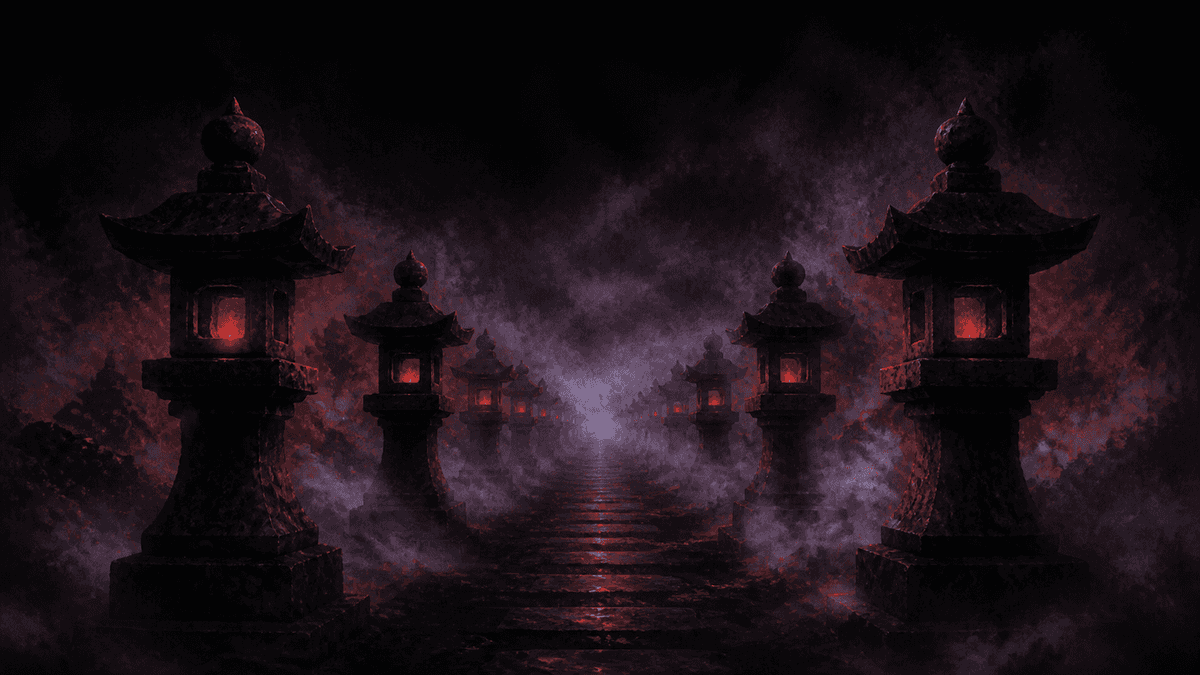
"Who is Datsueba?" She is the fearsome old hag of tradition who waits for the dead at the bank of the Sanzu, the river of the dead. This article traces who she is, from the origin of her name to her Edo-era cult, from both a Buddhist and a folkloric view.
Who Datsueba is
Datsueba is the old hag demon said to stand at the bank of the river of the dead and strip the robes of the dead who cross it. At the boundary from this world to the next, the dead are said to first be stripped of what they wear. The stripped robe is hung on the branch of a great tree by the river called the "robe-hanging tree" (eryoju), and the weight of one's sins in life is measured by how far the branch bends.
For all her fearsome telling, at her core lies the idea that "at the very gateway to the next world, one's deeds in life already begin to be questioned." Datsueba is depicted as the keeper of the first barrier of judgment.
Her other names, and the source text
Datsueba goes by many names — Datsue-ba, Sozukaba, Shozuka-no-baba, Ubagami, Ubason — called differently by region and by faith.
Her name appears clearly in the "Ten Kings Sutra" (Jizo Juo-kyo), said to have taken shape in Japan late in the twelfth century. Yet an earlier prototype is said to appear as a "hag demon" in the eleventh-century tale collection Hokke Genki. Tellingly, the Chinese source texts behind the Ten Kings cult are said to hold no image of Datsueba and Keneo as a pair. The concrete device of weighing robes on the robe-hanging tree is thought to be a distinctly Japanese vision of the afterlife. For the ten judges centered on King Enma, see also What the Ten Kings Are.
Why she strips the robes — the tree and Keneo
Datsueba does not strip robes out of mere plunder. It is said to be for measuring the gravity of sin — the robe is hung on the tree, and how far the branch sags reveals how heavy the karma is. The graver the sin, the heavier the robe and the more the branch bends. The karma measured this way is said to inform Lord Enma's later judgment.
She has a partner in this work: an old man demon called Keneo, said to hang the robes Datsueba strips onto the branch of the robe-hanging tree. Datsueba strips, Keneo weighs — the pair have long been told to keep the barrier at the river together.
The river's three crossings
The Sanzu where Datsueba waits is said to offer three ways across, according to one's deeds in life. Those who did good cross a bridge; those with light sins wade a shallow ford; those with heavy sins are made to cross a swift, deep current. The custom of sending the dead off with six coins as a toll also belongs to this river. Datsueba, it is said, strips the robe of one who carries no toll in its place. For the river itself, see The Meaning of the Sanzu River.
Her Edo-era cult — the hag who cures coughs
Even as she was told of as a dread demon, by the late Edo period Datsueba also became an object of everyday devotion. She was best known for a power over coughs: believed to ward off children's whooping cough and epidemic disease, and small halls were raised to her across the land. At Shojuin in Shinjuku, Tokyo, where cotton was offered when a cough was cured, she was fondly called the "cotton grandmother." The folklorist Kunio Yanagita saw this cult as an old native belief in hag-deities (ubagami) fused and transformed by Buddhism. A dread gatekeeper and a guardian who wards off illness — Datsueba has been handed down as a figure holding both faces at once.
Yurusen's world and Datsueba
This hag lives on in the world of the app "Yurusen." The act of stripping a robe also symbolizes peeling away the surface to reveal a person's "type." However smoothly the other person talks their way out, in the memory of the one who was wronged that deed still bends the branch with its full weight.
The one who was wronged is under no obligation to let everything go. Yurusen is a place to quietly discern the type of the one who hurt you and bind it into the ledger. Robesnatch, who strips the robes at the river, and the other wraiths can be seen on the Wraith Codex page.
FAQ
Frequently asked questions
Q.Who is Datsueba?
Datsueba is the old hag said to stand at the bank of the river of the dead and strip the robes of the dead who cross it. Tradition holds that the stripped robes are hung on the branch of a nearby tree, and the weight of one's sins in life is measured by how far the branch bends.
Q.Why does Datsueba strip the robes?
It is said to be for measuring the gravity of sin — the robe is hung on a tree, and the branch's sag reveals how heavy the sin is. The graver the sin, the heavier the robe and the more the branch bends. This is said to inform Lord Enma's later judgment.
Q.Who is 'Keneo,' who appears alongside Datsueba?
Keneo is the old man said to hang the robes Datsueba strips onto the tree branch. Datsueba strips the robe and Keneo hangs it to weigh the sin — the pair are said to keep the barrier at the river of the dead together.
Q.How far back is Datsueba told of?
Her name appears clearly in the 'Ten Kings Sutra' (Jizo Juo-kyo), an apocryphal text said to have taken shape in Japan late in the twelfth century. An earlier prototype, a 'hag demon,' is said to appear in the eleventh-century tale collection Hokke Genki. By the late Edo period she had also become an object of popular devotion, known for curing coughs.
About the author
Katsuki Mitsumori三森 捷暉
CEO, SURISUTA K.K. / Operator of Doya Marke AI
Runs Doya Marke AI, a suite of practical AI services spanning content, ads, sales and HR, and hosts the YouTube channel 'SaaS wa Shinimasshen.' Creator and developer of Yurusen, an app for filing the people you could never forgive into a private ledger of judgment.
RELATED
Related reads
 Enma & Hell
'Heaven's Net Is Wide and Loose, Yet Nothing Slips Through' — Meaning, Origin, and the Wait
The proverb says heaven's net looks coarse-meshed yet never lets a wrongdoer escape. This piece covers its source in the Laozi, how it differs from inga ouhou, and where to put the feeling of waiting for a reckoning that will not come.
 Enma & Hell
What the Six Coins Mean — the Toll for the Sanzu River and the Sanada Crest
The six coins are the toll placed with the dead for crossing the Sanzu River. This piece covers why the number is six (one for each of the six realms), the burial custom and its paper form today, and what the Sanada clan meant by putting the coins on their crest.
 Enma & Hell
What Chikushodo Means — the Realm of Beasts, and the Weight of the Word 'Chikusho'
Chikushodo is the realm of the six where one is born as bird, beast, insect or fish, preying on one another and driven by others. This piece covers how it differs from the hungry-ghost and asura realms, why 'chikusho' became an insult, and what we can still see in it.