What Is the Blood-Pond Hell — From the Blood Bowl Sutra to Beppu's Hot Springs
The "Blood-Pond Hell" is the tradition of being sunk into a dark-red pool of blood. This article traces its meaning and origin — the historical Blood Bowl Sutra and its notions about women, the picture-preaching of the Kumano nuns, and its familiar life as the name of hot-spring sites — from a Buddhist and folkloric view, then bridges to the world of Yurusen.
By Katsuki Mitsumori
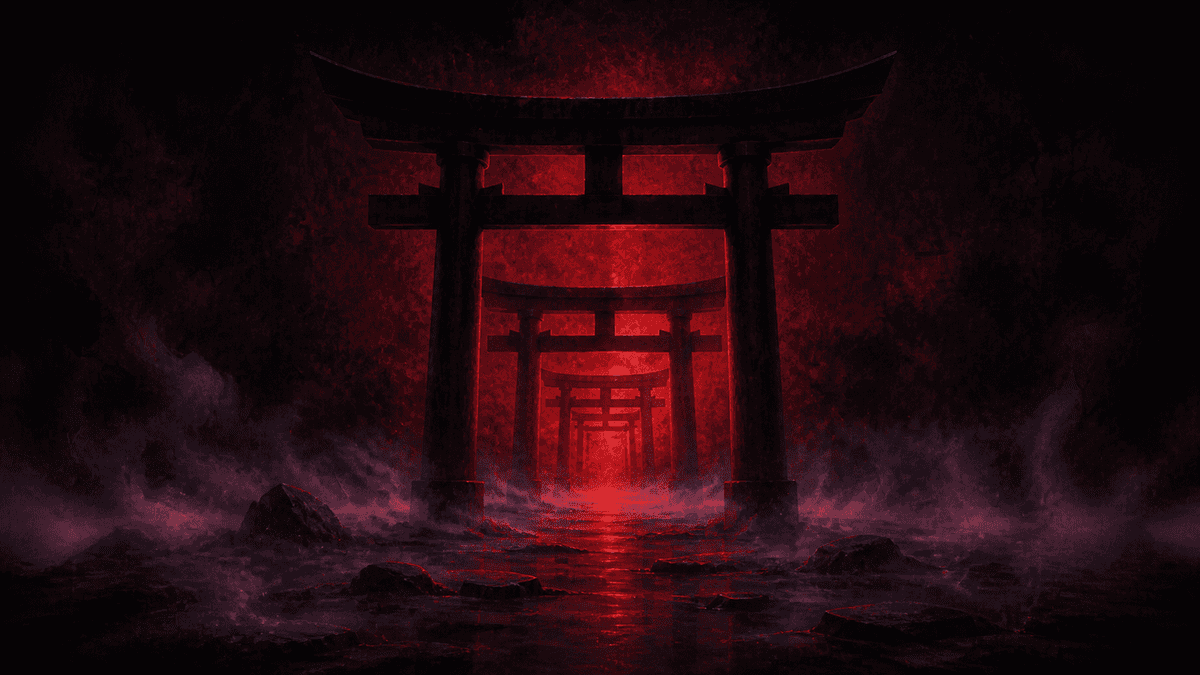
The damned sinking, inch by inch, into a dark-red pool of blood — the "Blood-Pond Hell" is among the most vivid scenes ever drawn in hell scrolls. This article traces its meaning and origin — reaching as far as the Blood Bowl Sutra and Beppu's hot springs — from a Buddhist and folkloric view.
What is the Blood-Pond Hell
The Blood-Pond Hell is the traditional place where the damned are sunk into a pool clouded red like blood and made to suffer. Struggling but unable to climb out, swallowed by the red water — this figure has been drawn again and again as a stock scene of the hell scrolls.
The red of the blood is said to reflect the blood one caused to be shed in life, and the weight of the lives one wounded. The Blood-Pond Hell is thought to be not merely a fearsome pool, but a visible form of the principle of cause and effect: that deeds of wounding others remain as the color of that blood. For where it sits within the wider map of the hells, see also What Are the Eight Great Hells.
Its origin and how it was told
The image of the blood pond grew within the view of hell set out in the scriptures and within the didactic tales that surround it. The scene of sinking into red water joined with old dreads around life and blood, giving rise to varied traditions region by region. Such tellings are said to reflect, in vivid color, the view of life and death of each era and its notions around blood.
There are various accounts, but common to all is the gaze that grasps the red of blood as a symbol of "a weight that must be atoned for."
The Blood Bowl Sutra and notions about women
Unavoidable in speaking of the Blood-Pond Hell is a text called the Blood Bowl Sutra (Ketsubonkyo). A small sutra of just over four hundred and twenty characters, it is said to have been preached to save women held to have fallen into hell through the impurity of blood. It spread in Ming- and Qing-era China and took on a distinct development in Japan from the Muromachi period on.
In the Japanese Blood Bowl Sutra, the blood of childbirth was at first the issue; in the Edo period menstrual blood was added, and in time it came to be preached that "any woman at all falls into the Blood-Pond Hell." This was a doctrine born of the fusion of an old notion of blood defilement — that the blood of birth and menstruation pollutes the gods of land and water — with the Buddhist view of women as unclean.
It must be added, for clarity, that such teachings are historical, heavily reflecting that era's notions of blood impurity and its view of women. They are scarcely believed today, and the tradition is said to survive only in a very few places, such as Shosenji temple in Chiba. It is a passage worth grasping, as fact, for understanding the history of the Blood-Pond Hell.
The picture-preaching of the Kumano nuns
Those who carried the tales of the Blood Bowl Sutra and the Blood-Pond Hell from village to village were women religious called the Kumano nuns (Kumano bikuni). Holding up a single painted scroll, the "Kumano Kanshin Jikkai Mandala," they preached the scenes of hell and paradise to the people by picture-preaching. Within that mandala, the figure of a woman sinking into a blood pond is clearly drawn. This work of conveying the underworld not through letters but through picture and voice became a great force in rooting the image of the Blood-Pond Hell widely among ordinary people.
The 'Blood-Pond Hell' of hot springs
As represented by the "Blood-Pond Hell" of Beppu, Oita, hot-spring sites across the land have springs bearing the name of hell. Beppu's is a pool dyed red by iron-oxide-rich hot mud welling up from the strata; it is designated a national scenic site and even called Japan's oldest natural "hell." Records show the custom of the "Beppu hell tour" already existed in the Edo period. These are not hell itself, but names that overlay hell's ferocity onto an earthly landscape. For the difference between hell and paradise, see also The Difference Between Hell and Paradise.
Yurusen's world and the blood pond
Yurusen is a private app for filing "the people you cannot forgive" into a ledger of judgment and passing verdicts. When we put into words a memory of being wounded by someone, we quietly gaze on the very thing the Blood-Pond Hell has always conveyed — the weight of wounding and being wounded.
The forms of those fallen into hell are gathered on the Wraith Codex page. Go and find, there, the "type" that sinks into the red pool.
FAQ
Frequently asked questions
Q.What kind of place is the Blood-Pond Hell said to be?
It is the traditional place where the damned are sunk into a dark-red, blood-like pool and made to suffer. The red of the blood is told as reflecting the blood one caused to be shed in life, and the weight of the lives one wounded.
Q.Is it the same as the 'Blood-Pond Hell' at hot-spring sites?
Same origin, different nature. The 'Blood-Pond Hells' in places like Beppu, Oita, are tourist springs named after the scene of hell — sources dyed red by iron. They are not hell itself, but a name that overlays hell's ferocity onto an earthly landscape.
Q.Is it true the Blood-Pond Hell is a hell women fall into?
A sutra called the Blood Bowl Sutra historically taught that women fall into this hell because of the impurity of childbirth and menstrual blood. But this heavily reflects that era's notions of blood impurity and its view of women as unclean, and is scarcely believed today. It is worth knowing as historical background.
About the author
Katsuki Mitsumori三森 捷暉
CEO, SURISUTA K.K. / Operator of Doya Marke AI
Runs Doya Marke AI, a suite of practical AI services spanning content, ads, sales and HR, and hosts the YouTube channel 'SaaS wa Shinimasshen.' Creator and developer of Yurusen, an app for filing the people you could never forgive into a private ledger of judgment.
RELATED
Related reads
 Enma & Hell
'Heaven's Net Is Wide and Loose, Yet Nothing Slips Through' — Meaning, Origin, and the Wait
The proverb says heaven's net looks coarse-meshed yet never lets a wrongdoer escape. This piece covers its source in the Laozi, how it differs from inga ouhou, and where to put the feeling of waiting for a reckoning that will not come.
 Enma & Hell
What the Six Coins Mean — the Toll for the Sanzu River and the Sanada Crest
The six coins are the toll placed with the dead for crossing the Sanzu River. This piece covers why the number is six (one for each of the six realms), the burial custom and its paper form today, and what the Sanada clan meant by putting the coins on their crest.
 Enma & Hell
What Chikushodo Means — the Realm of Beasts, and the Weight of the Word 'Chikusho'
Chikushodo is the realm of the six where one is born as bird, beast, insect or fish, preying on one another and driven by others. This piece covers how it differs from the hungry-ghost and asura realms, why 'chikusho' became an insult, and what we can still see in it.