What Are the Eight Great Hells — Types, Order, and the Sins They Answer
The Eight Great Hells are the eight hells taught in Buddhism, from the Reviving Hell to the Hell of No Interval. This piece explains each type and its order, the sins of the five precepts they answer to, their staggering lifespans (kalpas), the sixteen sub-hells, and how they differ from the eight cold hells, then bridges to the world of Yurusen.
By Katsuki Mitsumori
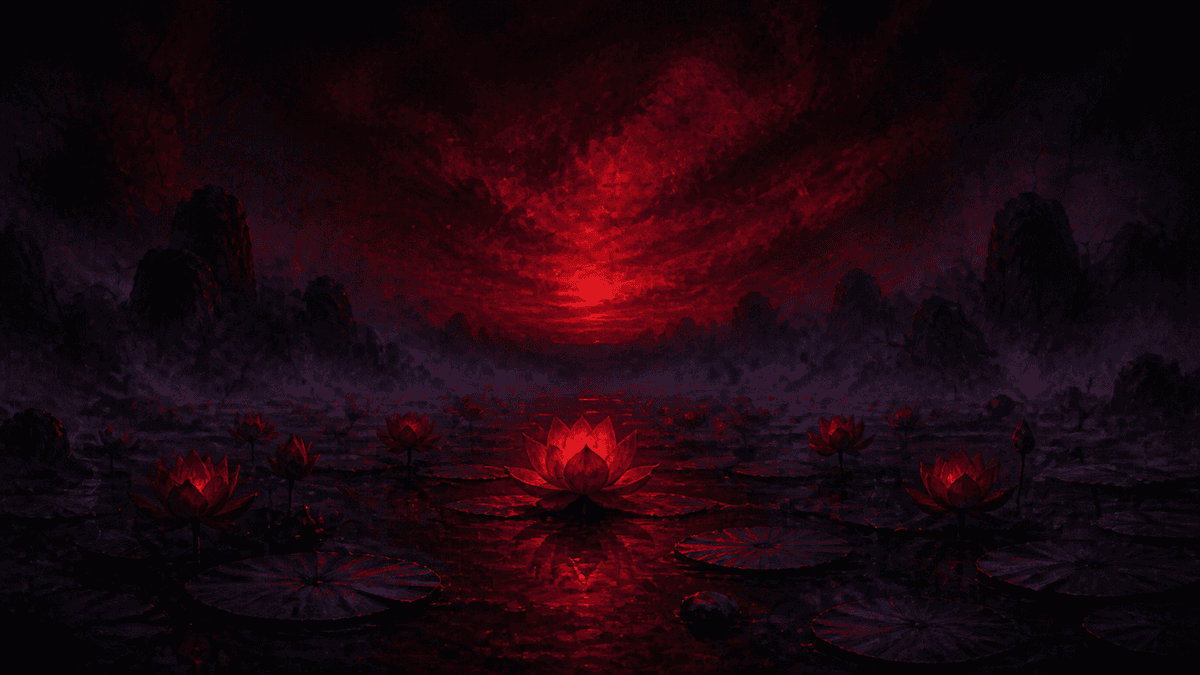
"What are the Eight Great Hells?" Many have heard the name yet few know what it contains. This article gently explains the eight hells taught in Buddhism — their types, their order, and the sins they answer to — along with their sources.
What the Eight Great Hells are
The Eight Great Hells are the eight hells taught in Buddhism. They are said to be stacked in layers deep underground; the further down you go, the graver the sin and the greater the suffering. By their deeds in life, the dead are said to fall into one of them.
Because every one of these hells torments the dead with flame and searing heat, they are also called the "eight hot hells," as a pair to the eight cold hells that torment with cold.
The source — the "Essentials of Rebirth" and Genshin
The basis for this view of hell lies in Buddhist scriptures such as the Saddharma-smrtyupasthana Sutra and the Abhidharmakosa. In Japan it became widely known through the "Essentials of Rebirth" (Ojo Yoshu, 985) by the Heian-era monk Genshin (942–1017).
By depicting the horrors of hell vividly, Genshin taught a heart that wearies of this world's suffering and longs for rebirth in the Pure Land. Much of the later hell imagery and folklore takes its cue from this book's descriptions.
The eight types and the sins they answer
The Eight Great Hells are generally arranged in this order. Note how, with each added sin, one falls into a deeper hell.
- Reviving Hell: the shallowest, for those who took life. The dead wound one another, are revived by a cool breeze, and repeat the torment — hence the name "revive alike."
- Black Rope Hell: for those who added theft to killing. They are marked with a black inked cord and cut along its lines.
- Crushing Hell: for those who further added illicit desire. They are crushed between closing mountains and torment in a forest of sword-like leaves.
- Screaming Hell: where sins like intoxication are added and one cries out in boiling water and flame.
- Great Screaming Hell: where the sin of lying is added and one cries out still more fiercely.
- Scorching Hell: a burning hell for wrong views, such as teaching false doctrine.
- Great Scorching Hell: where more sins pile up and the burning grows fiercer.
- Hell of No Interval (Avici): the lowest layer, the Hell of No Interval, answering to the gravest sins, such as the five grave offenses.
Staggering lifespans — the "kalpa"
Another defining feature of the Eight Great Hells is the length of the sentence. The scriptures say that even the shallowest Reviving Hell far exceeds a trillion human years, and the figures grow by orders of magnitude further down, until the lowest Hell of No Interval reaches "a middle kalpa," an unimaginable span.
These are symbols of the weight of sin expressed through the sheer vastness of time, rather than actual years. That uncountable length is itself a device for making cause and effect felt in the body.
The sixteen sub-hells
The Eight Great Hells do not end at eight. Outside the four gates of each hell are said to lie sixteen "sub-hells," where the torments branch out according to the finer kinds of sin.
Scenes like the Mountain of Needles, which also appears in Yurusen's codex, often derive from these sub-hell descriptions. The Eight Great Hells are not merely eight layers but a vast world-image subdivided into as many torments as there are sins.
Hell within the six realms
The Eight Great Hells do not stand alone; in Buddhism they sit at the very bottom of the "six realms" — hell, hungry ghosts, animals, warring spirits, humans, and heaven, the six worlds of delusion. Within the idea of rebirth, where your deeds in life decide where you are next born, hell is only one "path" among these.
Worth keeping in mind is that hell is said not to be eternal. However long it lasts, once the set sentence is served, the dead are taught to be reborn once more onto another path. That hell has been told of as an occasion to mend one's conduct, rather than to punish without end, can be glimpsed here too.
Yurusen's "seven judgments"
Building on this view of hell, the app "Yurusen" expresses the weight of your feeling toward an "unforgivable person" as seven tiers of judgment. From the lightest Admonition to the highest, Ten Kings Descend, you can quietly choose a judgment to fit the type of person and the depth of your feeling.
This is not to truly punish anyone, but a mechanism that gives a "shape" — a tier — to feelings with nowhere to go, shrinking them to a manageable size. You are under no obligation to force yourself to forgive. The wraiths that appear at the end of judgment can be seen on the Wraith Codex page.
FAQ
Frequently asked questions
Q.What are the Eight Great Hells?
The Eight Great Hells are the eight hells taught in Buddhism. The Reviving, Black Rope, Crushing, Screaming, Great Screaming, Scorching, Great Scorching, and No Interval hells are said to be stacked underground from lighter to graver sins, and the deeper you fall, the greater the suffering. Because they torment with heat, they are also called the eight hot hells.
Q.In what order are the Eight Great Hells arranged?
They are generally given as the Reviving, Black Rope, Crushing, Screaming, Great Screaming, Scorching, Great Scorching, and No Interval hells. The uppermost Reviving Hell corresponds to the lightest sins, and the lowest, the Hell of No Interval, to the gravest.
Q.Which deeds correspond to which hell?
Accounts vary, but the scriptures say that as breaches of the five precepts (no killing, no stealing, no illicit desire, no intoxication, no lying) accumulate, one falls deeper — killing leads to the Reviving Hell, adding theft to the Black Rope Hell, and so on, while the lowest, the Hell of No Interval, answers to the gravest sins such as harming a parent.
Q.How long is the sentence in the Eight Great Hells?
The scriptures give dizzying lifespans for each hell. Even the shallowest Reviving Hell exceeds a trillion human years, and the figures grow by orders of magnitude further down, until the lowest Hell of No Interval reaches 'a middle kalpa,' an unimaginable span of Buddhist time. These are symbols of the weight of sin expressed as length of time, not literal measurements.
About the author
Katsuki Mitsumori三森 捷暉
CEO, SURISUTA K.K. / Operator of Doya Marke AI
Runs Doya Marke AI, a suite of practical AI services spanning content, ads, sales and HR, and hosts the YouTube channel 'SaaS wa Shinimasshen.' Creator and developer of Yurusen, an app for filing the people you could never forgive into a private ledger of judgment.
RELATED
Related reads
 Enma & Hell
'Heaven's Net Is Wide and Loose, Yet Nothing Slips Through' — Meaning, Origin, and the Wait
The proverb says heaven's net looks coarse-meshed yet never lets a wrongdoer escape. This piece covers its source in the Laozi, how it differs from inga ouhou, and where to put the feeling of waiting for a reckoning that will not come.
 Enma & Hell
What the Six Coins Mean — the Toll for the Sanzu River and the Sanada Crest
The six coins are the toll placed with the dead for crossing the Sanzu River. This piece covers why the number is six (one for each of the six realms), the burial custom and its paper form today, and what the Sanada clan meant by putting the coins on their crest.
 Enma & Hell
What Chikushodo Means — the Realm of Beasts, and the Weight of the Word 'Chikusho'
Chikushodo is the realm of the six where one is born as bird, beast, insect or fish, preying on one another and driven by others. This piece covers how it differs from the hungry-ghost and asura realms, why 'chikusho' became an insult, and what we can still see in it.