Who Is Lord Enma — Origin, Role, and Link to Jizo, Explained
Lord Enma is the king said to judge the dead by their deeds in life. This piece explains his origin in the Indian death-god Yama, his role among the Ten Kings of the underworld, the belief that he is a form of the bodhisattva Jizo, and his ties to Enma's ledger and the jouhari mirror, then bridges to the world of Yurusen.
By Katsuki Mitsumori

"Who is Lord Enma?" Many know the name yet cannot explain his role. This article gently explains Lord Enma — long feared as the king who judges the dead in hell — from his origin to the meaning held in his images.
Who Lord Enma is
Lord Enma is the king said to rule hell and judge the deeds of the dead. When a person dies, their soul is said to be brought before Lord Enma and questioned, one by one, on the good and evil of their life.
What Lord Enma holds is "Enma's ledger," the record of one's deeds. He is said to weigh that record against the scene of one's past life reflected in the jouhari mirror set at his side, gauge the gravity of sin, and hand down a verdict. However much you talk your way around it, the deed itself appears as evidence — that is what it means to stand before this king.
His identity and origin — the Indian death-god Yama
Lord Enma's roots are said to lie in "Yama," a god who appears in ancient Indian scriptures such as the Rig Veda. Yama was the first human to die, and so, as the one who first found the road to the world beyond, he is said to have become the king of the dead who guides departed souls.
This Yama was taken into Buddhism as "Enma" and spread, with the scriptures, to China and then Japan. It is worth remembering that he was originally less an object of terror than a being who led the dead to a peaceful world — a nuance to hold alongside his later face as a "judge."
As one of the Ten Kings of the underworld
Having crossed into China, Yama merged with Daoist views of the underworld and was systematized as one of the Ten Kings who judge the dead in turn. Among them, King Enma is the fifth, said to preside over the hearing on the thirty-fifth day after death.
In Japan too, Enma has been widely embraced as the figure who represents the judgments of the "intermediate state" that runs from the seventh day to the forty-ninth. The idea that a different king judges on each memorial day is bound up with the custom of holding services at which the bereaved recall the deceased.
The belief that he is a form of Jizo
Even as he is drawn as a fearsome judge, in Japan Lord Enma has long been told to be a form (honji) of the bodhisattva Jizo. The stern Enma who judges sin and the merciful Jizo who travels the six realms to save beings — that these seeming opposites are said to be two sides of one coin expresses the idea that "the severity of judgment is also the reverse face of the salvation that calls us to live rightly."
The real meaning of the "pulling out tongues" tale
Lord Enma is known for the tale of pulling out the tongues of liars. Yet this is said to be less about punishment than a lesson in the importance of honesty — which is also why it was passed down as a way of teaching children.
A bright-red face, eyes flung wide, robes like a Tang-dynasty judge, a ritual tablet in hand — even such a fearsome image is not there merely to frighten. It can also be seen as a "mirror" set up to make people reflect on their own conduct.
Festivals connected with Enma
Enma has not simply been kept at arm's length as a figure of dread. The sixteenth of January and the sixteenth of July are called "Enma's feast days," when the lid of hell's cauldron is said to open and even demons and the dead take a rest. On these days there is a custom of visiting local Enma halls — a practice that overlapped with the "servants' holidays," when live-in workers returned to their families, and so grew dear to ordinary people. A judge who nonetheless draws quietly close at the turning points of daily life — this double face, too, speaks to the depth of Enma worship.
The Enma within Yurusen
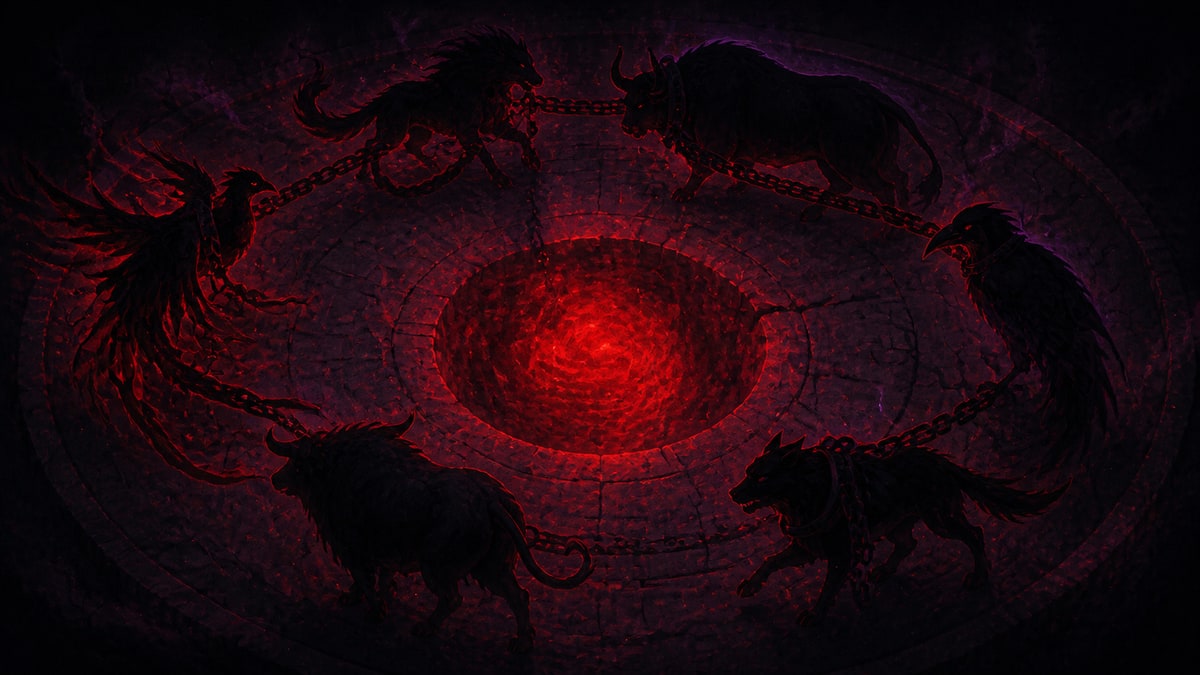
This figure of Enma lives on in the world of the app "Yurusen." Lord Enma, who binds together the root of every ledger of judgment, is depicted standing at the deepest part of the Wraith Codex.
If Enma is the one who "judges" sin, then your own resolve when you decide you cannot forgive someone is also a form of judgment. The one who was wronged is under no obligation to let everything go. Yurusen is your private ledger, a place to quietly entrust feelings with nowhere else to go.
You can view Enma and the other wraiths on the Wraith Codex page.
FAQ
Frequently asked questions
Q.Who is Lord Enma?
Lord Enma is the king said to rule hell and judge the dead by their deeds in life. He derives from 'Yama,' the death-god of ancient Indian myth, and spread with Buddhism to China and Japan, where he became widely believed in as a judge-like figure who weighs the sins of the dead and is counted among the Ten Kings of the underworld.
Q.How is Lord Enma related to the bodhisattva Jizo?
In Japan it has long been told that Lord Enma is a form (honji) of the bodhisattva Jizo. The stern Enma who judges sin and the merciful Jizo who saves beings are said to be two sides of one coin, expressing the idea that the severity of judgment is itself the reverse face of a call to live rightly.
Q.Does Lord Enma really pull out tongues?
The tale of pulling out the tongues of liars is said to be less about punishment than a lesson in the importance of honesty. It was also handed down as a way to teach children. Even his fearsome statues are thought to be set up as a 'mirror' that makes the viewer reflect on their own conduct.
Q.How does Lord Enma relate to Enma's ledger?
Lord Enma is said to hold 'Enma's ledger,' the record of a person's deeds, and to hand down judgment by weighing it against the scene shown in the jouhari mirror at his side. The ledger is the record that lets Lord Enma judge fairly.
About the author
Katsuki Mitsumori三森 捷暉
CEO, SURISUTA K.K. / Operator of Doya Marke AI
Runs Doya Marke AI, a suite of practical AI services spanning content, ads, sales and HR, and hosts the YouTube channel 'SaaS wa Shinimasshen.' Creator and developer of Yurusen, an app for filing the people you could never forgive into a private ledger of judgment.
RELATED
Related reads
 Enma & Hell
'Heaven's Net Is Wide and Loose, Yet Nothing Slips Through' — Meaning, Origin, and the Wait
The proverb says heaven's net looks coarse-meshed yet never lets a wrongdoer escape. This piece covers its source in the Laozi, how it differs from inga ouhou, and where to put the feeling of waiting for a reckoning that will not come.
 Enma & Hell
What the Six Coins Mean — the Toll for the Sanzu River and the Sanada Crest
The six coins are the toll placed with the dead for crossing the Sanzu River. This piece covers why the number is six (one for each of the six realms), the burial custom and its paper form today, and what the Sanada clan meant by putting the coins on their crest.
 Enma & Hell
What Chikushodo Means — the Realm of Beasts, and the Weight of the Word 'Chikusho'
Chikushodo is the realm of the six where one is born as bird, beast, insect or fish, preying on one another and driven by others. This piece covers how it differs from the hungry-ghost and asura realms, why 'chikusho' became an insult, and what we can still see in it.