What Is the Jouhari Mirror — The Mirror That Reflects a Life Before Enma
The jouhari mirror (jouhari-no-kagami) is set in King Enma's court and is said to reflect every deed of a dead person's life. This article traces the meaning of its other name "karma mirror," the origin of the word jouhari, its spread from Ten Kings paintings into Japanese hell art and folk theater, and the lesson that deeds cannot be hidden — then bridges to the world of Yurusen.
By Katsuki Mitsumori
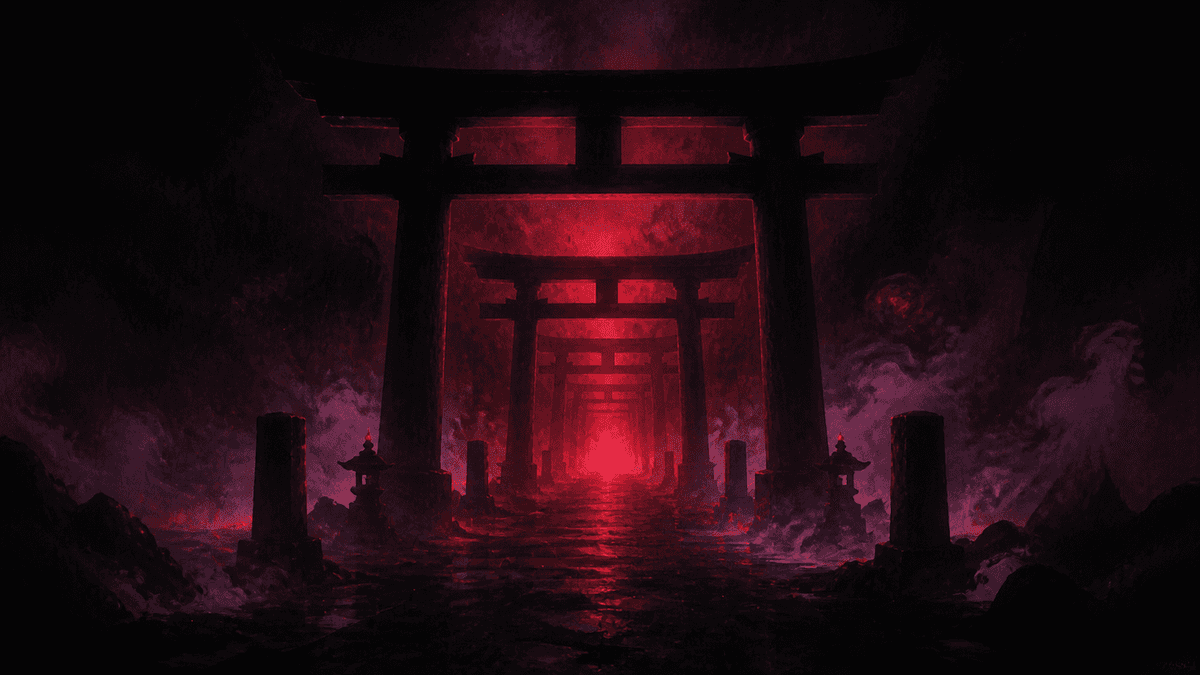
"Lie as you may, it shows in the jouhari mirror" — so it has long been told. The jouhari mirror is set before King Enma and is said to reflect, without exception, every deed of a dead person's life. This article traces that tradition, from the origin of its name to the history of its imagery, from a Buddhist and folkloric view.
What is the jouhari mirror
The jouhari mirror (jouhari-no-kagami) stands in the court of King Enma in hell and is said to reflect the good and evil deeds of the dead. However a dead person tries to explain things away, before this mirror both the good and the bad of one's former life are replayed vividly as living scenes. In the place of judgment, not words but "the deeds themselves" appear as evidence — this is the role entrusted to the mirror.
King Enma stands at the center of the ten kings who judge the dead, and this mirror is said to be set in his court. Through it he confirms a whole life and decides where the soul will go — such a scene has long been handed down. For more on Enma, see also Who Is the Great King Enma.
The other name "karma mirror," and the word jouhari
This mirror has another name. It is called the karma mirror (gokyo) — or the retribution mirror. "Karma" here means the deeds done through body, speech, and mind. The name itself states what the mirror is: a mirror that reflects deeds. The karma one has piled up rises up as an image, just as it was. For more on karma, see What Is Karma (Gou).
The word "jouhari" is just as telling. Hari derives from the Sanskrit "hari," a translucent gemstone or crystal, and "jou" means clear and unclouded. Jouhari, then, carries the sense of pure, cloudless crystal. Because there is no murk in it, nothing can be hidden from what it reflects. By extension, to say someone has "eyes like the jouhari mirror" is to praise a keen discernment that sees through to good and evil.
What the mirror reflects: the deed and its ripples
The dread of the jouhari mirror is not merely that "wrongdoing gets exposed." According to the tradition, what the mirror shows is not only one's own actions, but also the effect those actions had on the people around — who was made to suffer, and how sad they were made to feel.
In other words, the mirror confronts you not only with "what you did" but with the whole ripple of "what wound it left, and in whom." A slight you thought trivial, and how deeply it lodged in the other person's heart — if that is replayed as a living scene, there is no more inescapable evidence.
From Ten Kings paintings to Japan — the mirror in art and theater
The jouhari mirror became widely known partly through the power of painting. Scenes of judgment featuring this mirror grew prominent in the "Ten Kings paintings" of the Southern Song period in China, and were later carried into Japanese hell paintings and Ten Kings scrolls. Within a hell painting, the moment a dead person's evil deeds are cast onto the mirror's surface left a strong impression on all who saw it.
The mirror did not remain confined to painting. In folk performing arts such as Mibu Kyogen and Kirai-go, a mirror is said to be used as a prop that lays bare the truth in scenes of hell. For those who could not read, it was surely a way to convey, through the eyes and the body, the lesson that "deeds are always brought to light."
The lesson that deeds cannot be hidden
For all its fearsome telling, at the core of this mirror lies a plain warning. You may deceive the eyes of others, but you yourself know best what you have done — the jouhari mirror can be seen as that inner memory cast outward.
Here it is worth clearing up a common misreading. This mirror is not a device for punishing sinners alone. Beneath the dread lies a quiet call: "Live as though you are being watched." The severity of judgment is, turned around, an encouragement — that each single deed of your days carries that much weight.
Yurusen's world and the jouhari mirror
Yurusen is a private app for filing "the people you cannot forgive" into a ledger of judgment and passing verdicts. However smoothly the other person talks their way out, in the heart of the one who was wronged that deed remains, vivid and unfading. That is because the jouhari mirror within you never reflects a lie.
The one who was wronged is under no obligation to let everything go. When you put that memory into words and write it down, the ledger becomes your mirror — a mirror to show no one, only to confirm with your own eyes that "yes, this happened."
The forms of those living the worlds of hell and the six realms are gathered on the Wraith Codex page. Go and find, there, the "type" you would hold up to the mirror.
FAQ
Frequently asked questions
Q.What kind of mirror is the jouhari mirror?
A mirror set in King Enma's court, said to reflect every deed of a dead person's life. Clear as flawless crystal, it is told to replay both good deeds and bad as vivid scenes. It is also called the karma mirror (gokyo).
Q.What does the jouhari mirror reflect?
Not only the deeds themselves, but also, it is said, the effect those deeds had on others — who was hurt and how. It shows 'the deed and its ripples' as evidence, rather than words.
Q.What does the word jouhari mean?
Hari derives from a Sanskrit word for translucent gemstone or crystal, and jou means clear and unclouded. The name itself holds the mirror's nature: it reflects the truth without a single cloud.
About the author
Katsuki Mitsumori三森 捷暉
CEO, SURISUTA K.K. / Operator of Doya Marke AI
Runs Doya Marke AI, a suite of practical AI services spanning content, ads, sales and HR, and hosts the YouTube channel 'SaaS wa Shinimasshen.' Creator and developer of Yurusen, an app for filing the people you could never forgive into a private ledger of judgment.
RELATED
Related reads
 Enma & Hell
'Heaven's Net Is Wide and Loose, Yet Nothing Slips Through' — Meaning, Origin, and the Wait
The proverb says heaven's net looks coarse-meshed yet never lets a wrongdoer escape. This piece covers its source in the Laozi, how it differs from inga ouhou, and where to put the feeling of waiting for a reckoning that will not come.
 Enma & Hell
What the Six Coins Mean — the Toll for the Sanzu River and the Sanada Crest
The six coins are the toll placed with the dead for crossing the Sanzu River. This piece covers why the number is six (one for each of the six realms), the burial custom and its paper form today, and what the Sanada clan meant by putting the coins on their crest.
 Enma & Hell
What Chikushodo Means — the Realm of Beasts, and the Weight of the Word 'Chikusho'
Chikushodo is the realm of the six where one is born as bird, beast, insect or fish, preying on one another and driven by others. This piece covers how it differs from the hungry-ghost and asura realms, why 'chikusho' became an insult, and what we can still see in it.