What Is the Wraith Codex — A Hell's Catalog of Unforgivable Types
Yurusen's "Wraith Codex" casts the everyday types of unforgivable people as wraiths, demons, and hell-wardens fallen into hell. Meet the world of all 100 — up to the three lords at the summit of Enma's court.
By Katsuki Mitsumori
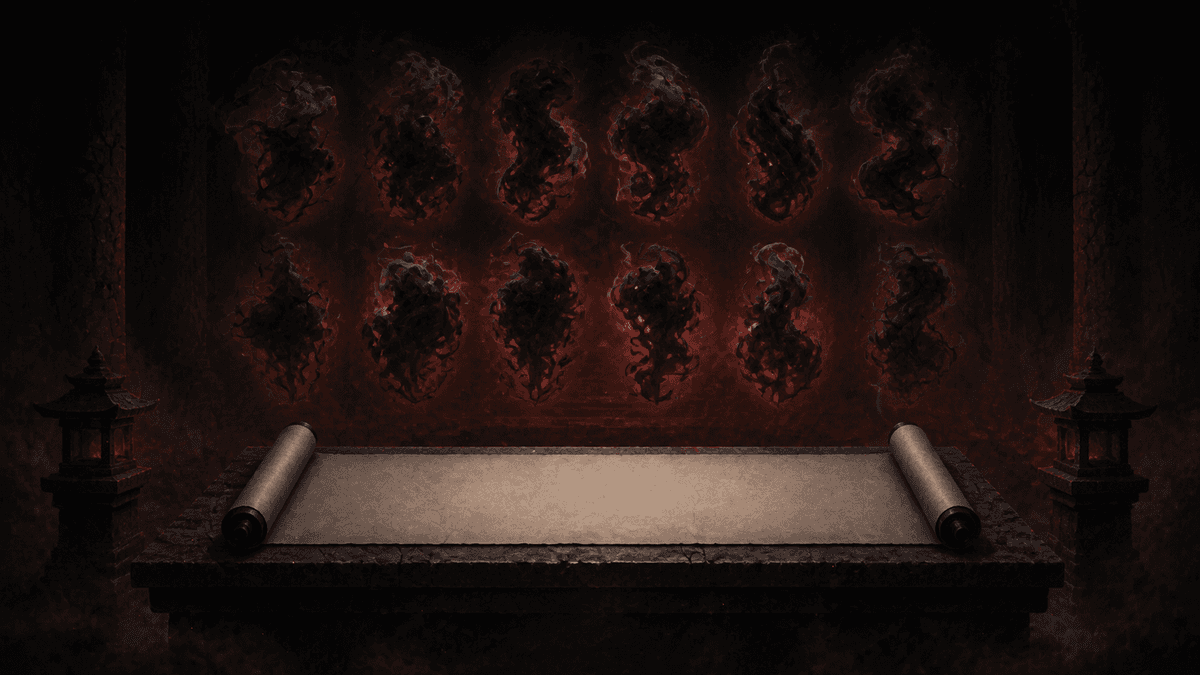
Yurusen includes a catalog of 100 called the "Wraith Codex." It gathers the everyday "types" of unforgivable people, cast in the form of wraiths, demons, and hell-wardens fallen into hell. This article introduces the world behind it and how it came to be.
Turning "types" into wraiths
The moments when we feel someone is "unforgivable" tend to follow a few set patterns. Never hearing you out. Skimming off the credit from the side. Treating a promise as if it never happened. Reading your message and never replying.
The Wraith Codex distills each of these behavioral "types" into a single wraith. The clingy person who keeps dredging up settled matters becomes "Nechi-nechi." The one who swings correctness around like a blunt weapon becomes "Gori-oshi." When a nameless irritation is given the name of a "type," you can, oddly, start to view it from a slight distance.
Four rarities
Wraiths come in four rarity tiers, from minor types to grave ones.
- N (Normal): minor, but genuinely unforgivable. The small everyday offenders — loud chewers, line-cutters, and the like.
- R (Rare): mid-level types. Ignoring messages, forcing "correct" arguments, binding people through comparison.
- SR (Super Rare): grave types and wardens. Deep-rooted patterns like flipping blame back, turning on a dime, and quiet controlling coldness.
- UR (Ultra Rare): the three lords at the summit of Enma's court.
The three lords at the summit
At the deepest part of the codex stand the beings who bind hell together. Lord Enma, who binds together the root of every ledger of judgment. Old Hag Robesnatch, who strips the robes of those crossing the river of the dead. And the king who severs forgiveness — Fuyurushi — who rises from bound-up resentment when the resolve of "never forgiven" is full.
If Enma is the one who "judges" sin, Fuyurushi is the one who "will not forgive." The very moment you decide, from the bottom of your heart, that you cannot forgive someone, that resolve itself takes the shape of this king.
Another meaning in collecting
The Wraith Codex has all the fun of a collection. But more than that, it's a tool for confirming which type the person who hurt you turned out to be.
Giving a faceless irritation a name, and viewing it as a wraith — this isn't to make light of the feeling, but one way to shrink it to a manageable size and quietly set it down.
You can browse the full codex on the Wraith Codex page. Go and find the "type" that got to you.
FAQ
Frequently asked questions
Q.Are the wraiths in the codex based on real people?
No. Each wraith symbolizes a 'type' of unforgivable person — behaviors like not listening, stealing credit, or breaking promises. None are modeled on any specific real individual.
Q.How many are there in total?
100 in all. Rarity ranges over four tiers, from N (Normal) for the minor types up to UR for the three lords at the summit of Enma's court. As you pass more judgments, they are gradually discovered into the codex.
Q.Is the Wraith Codex just something to collect?
Beyond the fun of collecting, it's also a tool for putting into words which type the person who hurt you turned out to be. When a nameless irritation is given the name of a 'type,' it becomes a little easier to view from a distance.
About the author
Katsuki Mitsumori三森 捷暉
CEO, SURISUTA K.K. / Operator of Doya Marke AI
Runs Doya Marke AI, a suite of practical AI services spanning content, ads, sales and HR, and hosts the YouTube channel 'SaaS wa Shinimasshen.' Creator and developer of Yurusen, an app for filing the people you could never forgive into a private ledger of judgment.
RELATED
Related reads
 Enma & Hell
'Heaven's Net Is Wide and Loose, Yet Nothing Slips Through' — Meaning, Origin, and the Wait
The proverb says heaven's net looks coarse-meshed yet never lets a wrongdoer escape. This piece covers its source in the Laozi, how it differs from inga ouhou, and where to put the feeling of waiting for a reckoning that will not come.
 Enma & Hell
What the Six Coins Mean — the Toll for the Sanzu River and the Sanada Crest
The six coins are the toll placed with the dead for crossing the Sanzu River. This piece covers why the number is six (one for each of the six realms), the burial custom and its paper form today, and what the Sanada clan meant by putting the coins on their crest.
 Enma & Hell
What Chikushodo Means — the Realm of Beasts, and the Weight of the Word 'Chikusho'
Chikushodo is the realm of the six where one is born as bird, beast, insect or fish, preying on one another and driven by others. This piece covers how it differs from the hungry-ghost and asura realms, why 'chikusho' became an insult, and what we can still see in it.