Racing Thoughts at Night That Won't Stop? A Way to Write and Empty Your Head to Sleep
The moment you lie down, the day's mistakes and tomorrow's worries flood in and you can't sleep. Why do thoughts race at night? Here's how to honor the bedtime thought loop instead of denying it — writing your head's contents onto paper, letting them go, and drifting off, little by little.
By Katsuki Mitsumori
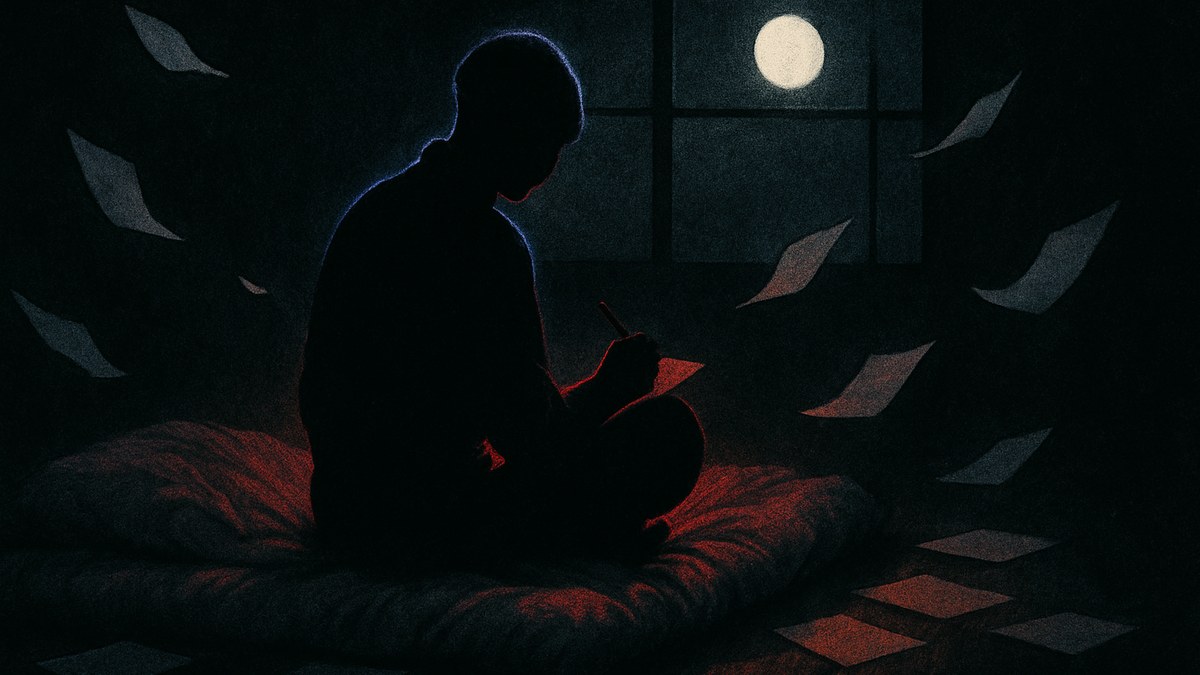
Lights off, in bed, nothing left to do but sleep. That's how it should be — yet the moment the quiet arrives, your head suddenly grows noisy. The needless remark you let slip today, the message you never replied to, the worry about tomorrow's schedule, a failure from years ago. As if they'd been waiting in line, thoughts flood in one after another, and your eyes grow wider awake.
The more you fret "I have to sleep soon," the more your thinking accelerates, and only the clock's hands move on. You know full well that thinking won't fix any of it right now, yet your head repeats the same things on its own. This article is about honoring the state where thoughts won't stop at night instead of denying it — writing your head's contents onto paper, letting them go, and drifting off to sleep, little by little.
Racing thoughts at night are natural
First, what I want you to hear: thoughts swelling at night is a natural phenomenon owing to the nature of the hours themselves, it's said. It isn't that your mind is weak, or that you lack willpower.
By day, your attention is turned toward work, dealings with people, the task in front of you; but as night comes and stimulation decreases, attention turns more easily inward. Then the anxiety and regret you'd set aside during the day float up. On top of that, night is a time when fatigue weakens the brakes on thinking, and thoughts flow easily toward the worse. Simply knowing that the conditions of night are creating this state where thoughts won't stop lightens the urge to blame yourself a little.
"Get it out for now" beats "don't think"
When they can't sleep, most people try "not to think." But trying to force a thought down tends, instead, to make that thought stronger, it's said. A suppressed thought comes rushing back the instant you let go.
So it helps, rather than suppressing, to get your head's contents onto paper for now. Put the thoughts circling in your head into words and set them outside, and your brain finds it easier to judge "I don't have to keep holding this," making it easier to let go. "I'm anxious about that thing tomorrow." "That one remark is bothering me." Bullet points are fine. Simply gathering what was scattered in your head into one place reliably quiets the inner noise.
When you finish, mark a "that's it" cut-off
The knack when writing is not to try to make it tidy. Getting out whatever fills your head right now, in the order it comes, is enough. There's no need to mind grammar or sequence. Because you do not have to show it to anyone, you can write without dressing it up.
And when you finish, mark a cut-off within yourself: "that's it for today." Entrusting the rest to tomorrow's self, gently close the notebook or app. "I've written what bothers me and gotten it outside, so I don't have to think about it now" — this small cut-off disbands the queue of thoughts waiting in your head and opens a doorway to sleep.
When sleepless nights continue, lean on a professional
If, even after writing, sleepless nights continue, and strong daytime drowsiness or low mood lasts more than two weeks and disrupts your life — when such states pile up, please don't carry it alone.
Sleep problems can be a sign of mental or physical trouble. When a sleepless state drags on, consider consulting a professional, such as a mental health clinic or a sleep clinic. Leaning on a professional isn't weakness; it's an act of protecting yourself. Alongside general measures like cutting back on caffeine and not staring at screens before bed, please take care not to push yourself too hard.
It's okay to let nighttime thoughts out as a "curse"
Chanting "let me not think" won't make the anxiety and regret welling up at night simply stop. Rather than forcing them away, it's far easier to write the thoughts down as they are and get them outside your head.
Noroi Nikki is an app for nights like that. There's no need to rethink it positively, and no need to make it tidy. Saved journal text is not public to other users. Nighttime thoughts swell the more you keep them in your head, and quiet the more you let them out. Write tonight's spinning while it's still tonight, empty your head, and get ready to drift off to sleep, little by little.
References
- Pennebaker, J. W. (1997). Writing about emotional experiences as a therapeutic process. Psychological Science, 8(3), 162–166. (A landmark study showing that expressive writing about painful experiences and emotions is linked to reduced mental and physical stress.)
FAQ
Frequently asked questions
Q.Why do thoughts stop being controllable at night?
At night, the day's stimulation and tasks decrease, so attention turns more easily inward, and the anxiety and regret you'd held down surface more readily, it's said. On top of that, it's a time when you're tired and the brakes on thinking don't work well. It isn't that your mind is weak — the nighttime hours themselves carry conditions that make thoughts easy to swell.
Q.The more I try not to think, the more I think. What can I do?
Trying to force a thought down tends, instead, to make that thought stronger, it's said. The recommendation is not to suppress it but to 'get it onto paper for now.' Put the thoughts circling in your head into words and set them outside, and your brain finds it easier to judge 'I don't have to keep holding this,' making it easier to let go.
Q.I don't know what to write before bed.
You don't have to make it tidy. Simply writing out, just as it is, whatever fills your head right now is enough. 'I'm anxious about that thing tomorrow.' 'That one remark from today is bothering me.' Bullet points are fine. When you finish, mark a cut-off — 'that's it for today' — and gently close the notebook or app, entrusting the rest to tomorrow's self.
Q.I can't sleep every night and it's disrupting my daytime life. What should I do?
If sleepless nights continue, and daytime drowsiness or low mood lasts more than two weeks and disrupts your life, please don't carry it alone. Sleep problems can be a sign of mental or physical trouble. Consider consulting a professional, such as a mental health clinic or a sleep clinic. Leaning on a professional isn't weakness; it's an act of protecting yourself.
About the author
Katsuki Mitsumori三森 捷暉
CEO, SURISUTA K.K. / Operator of Doya Marke AI
Runs Doya Marke AI, a suite of practical AI services spanning content, ads, sales and HR, and hosts the YouTube channel 'SaaS wa Shinimasshen.' Creator and developer of Noroi Nikki, an app for writing out and letting go of emotions.
This article explains folklore, language and culture. It is not medical, legal or religious advice. Traditions are introduced as culture, not as instructions to harm anyone. Claims without a source are marked as popular belief.
ZUKAN
Meet the yokai of this feeling



RELATED
Related reads
 Emotional care
Can't Sleep Because of Racing Thoughts at Night? A Bedtime Journaling Fix
The moment you lie down, the day replays and worries pile up, and sleep won't come. Here is a simple bedtime journaling routine to empty your head, break the loop of racing thoughts, and drift off calmly.
 Emotional care
Regret Keeping You Up at Night? Write Down the Past You Can't Redo and Set It Aside
The moment you lie down, that failure or that one thing you said comes back, and regret keeps you awake. Here's how to write the past you can't redo onto the page and set it down, on nights you keep replaying it.
 Emotional care
Left on Read and Spiraling: Writing to Distract Yourself While You Wait for a Reply
The message is read, but no reply comes, and you invent reasons until the unease won't stop. Here's how to ease the anxiety of waiting for a reply and distract yourself by writing before you interrogate your partner.