Regret Keeping You Up at Night? Write Down the Past You Can't Redo and Set It Aside
The moment you lie down, that failure or that one thing you said comes back, and regret keeps you awake. Here's how to write the past you can't redo onto the page and set it down, on nights you keep replaying it.
By Katsuki Mitsumori

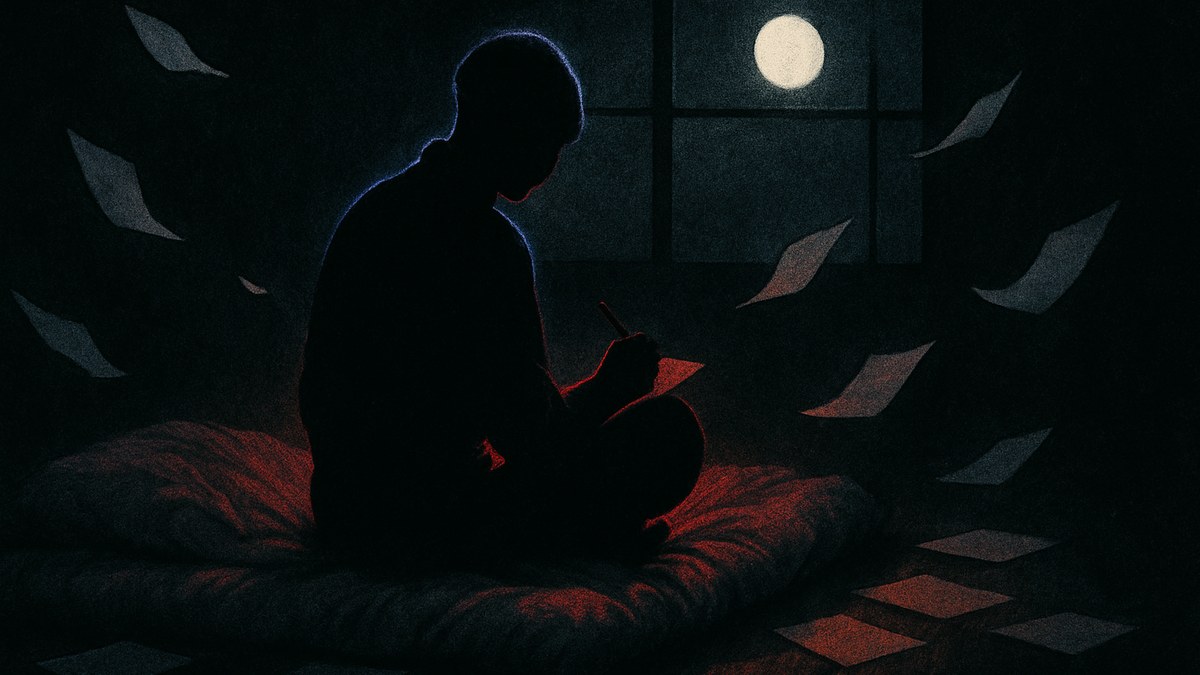
At the end of the day, you finally get into bed and close your eyes. And as if it had been waiting, that day's scene comes back: the one thing you shouldn't have said, the path you shouldn't have chosen, the moment you didn't make in time. It replays again and again in your head, and the words "if only I'd done it differently" won't stop.
Your body is tired, yet your mind alone is wide awake and can't sleep. You know you can't redo it, you know there's no use dwelling, and still you can't escape the loop of regret. The more the clock's hands move, the more anxiety about tomorrow piles on top. This article is about writing the past you can't redo onto the page and setting it down, on nights regret keeps you awake.
There's a reason regret returns at night
The first thing worth knowing is that remembering only regrets at night isn't because you have a negative personality. At night, daytime stimulation and tasks drop away, and as the mind quiets, inner thoughts come to the front more easily.
In bed especially, there's nothing else to do, and images surface readily once you close your eyes. Rumination — replaying painful past scenes over and over — happens most easily in exactly these quiet hours. In other words, being unable to sleep for regret isn't weak will; it's just that the quiet of night is a condition that makes rumination easy.
That's exactly why the response changes too. Instead of looping it in your head, get the regret outside for now. For nighttime regret, writing it out and letting it go works better than trying not to think.
Bring the loop in your head down onto paper
Regret hurts, in most cases, because the same scene loops in your head with no exit in sight. The more you think, the more the regret is polished sharp, and the further sleep recedes.
So it helps to write the regretted event in a space for your own writing. "Back then, I said this." "What I really wanted was this." "I still feel sorry." You don't have to make it pretty — write in the words that surfaced. Put into words, the circling thoughts pause once, and you can view them from the outside. Writing is said to act as a brake that stops rumination.
Regret that spread without limit in your head gains a clear outline on paper — "this much is what happened." What felt infinite returns to being a finite event. That alone lets you breathe a little.
Not "redo" but "set aside"
If you can't redo the past, writing about it feels pointless — you may feel that way. But the point of writing isn't to redo the past. The point is to change how you relate to it.
What happened can't be changed. But how you hold it in your heart can. Once you've written the regret and owned it, if there's even one thing to learn, try adding it. "Next time I'll say it sooner," or "I was doing my best back then, too" — either is fine. Picture it as marking closure on the regret and setting it on a shelf in your heart. Rather than sleeping while still carrying it, write down tonight's share and set it down before you sleep. Keep that up, and the pull back to the same regret weakens.
So you don't blame yourself too much
Behind regret usually hides a harshness toward yourself — "I should have done better." But the you of that moment surely chose as best you could, within the information and margin you had then. Judging the past from your present vantage is like blaming yourself for a problem you couldn't solve before you knew the answer.
When you write the regret out, write your circumstances at the time alongside it. "I had no margin then." "I thought that was the only way." Adding the circumstances as fact loosens the force of one-sided self-blame a little.
When sleepless nights keep going
Being unable to sleep for a while because of regret is natural, but it deserves attention when it lingers. If sleeplessness lasts more than two weeks, disrupts your daytime life, or comes with lingering low mood, it may be more than passing regret. Don't force yourself to carry it alone; consider talking to a mental health clinic or a sleep specialist.
It's okay to let the regret out as a "curse"
Even if your head knows "there's no use dwelling now," nighttime regret won't vanish so easily. Rather than forcing yourself to forget, it's far quicker to feel better by writing tonight's returning regret down as it is and getting it outside your head.
Noroi Nikki is an app for those nights. There's no need to convert it into positivity. Saved journal text is not public to other users. Regret grows heavier the longer you sleep while carrying it, and lighter the more you write it and set it down. Write tonight's share of regret while it's still tonight, set it aside, and sleep quietly.
References
- Pennebaker, J. W. (1997). Writing about emotional experiences as a therapeutic process. Psychological Science, 8(3), 162–166. (A landmark study showing that writing out painful experiences and emotions — expressive writing — is linked to reduced mental and physical stress.)
FAQ
Frequently asked questions
Q.Why do I remember only regrets at night?
At night, daytime stimulation and tasks drop away, and as the mind quiets, inner thoughts come to the front more easily. In bed especially, there's nothing else to do, so it's a time when past scenes replay readily. It isn't that you're negative; a quiet environment makes rumination easy. That's exactly why writing it out, instead of looping it in your head, works well for nighttime regret.
Q.I can't stop replaying regret in my head.
Thinking it through only in your head lets the same scene loop, making the exit hard to find. What helps is writing the regretted event onto paper. Put into words, the circling thoughts pause once, and you can view them from the outside. Writing is said to act as a brake that stops rumination.
Q.If I can't redo the past, isn't writing about it pointless?
The point of writing isn't to redo the past but to change how you relate to it. What happened can't be changed, but how you hold it can. Write the regret out and own it, and if there's something to learn, add one line of it. Marking that closure weakens the pull that keeps dragging you back to the same regret.
Q.What if sleepless nights from regret keep going and it's hard?
If sleeplessness lasts more than two weeks, disrupts your daytime life, or comes with lingering low mood, it may be more than passing regret. Don't force yourself to carry it alone; consider talking to a mental health clinic or a sleep specialist. Handling the sleeplessness itself is sometimes safer with a professional's help.
About the author
Katsuki Mitsumori三森 捷暉
CEO, SURISUTA K.K. / Operator of Doya Marke AI
Runs Doya Marke AI, a suite of practical AI services spanning content, ads, sales and HR, and hosts the YouTube channel 'SaaS wa Shinimasshen.' Creator and developer of Noroi Nikki, an app for writing out and letting go of emotions.
This article explains folklore, language and culture. It is not medical, legal or religious advice. Traditions are introduced as culture, not as instructions to harm anyone. Claims without a source are marked as popular belief.
ZUKAN
Meet the yokai of this feeling



RELATED
Related reads
 Emotional care
A Three-Minute Bedtime Journaling Habit: Let Go of the Day and Sleep
You get into bed but your mind is wide awake. A three-minute bedtime journaling habit helps on nights like these. Here's how to write out the feelings and worries you've stored up, empty your head, and sleep — plus how to keep the habit going.
 Emotional care
Racing Thoughts at Night That Won't Stop? A Way to Write and Empty Your Head to Sleep
The moment you lie down, the day's mistakes and tomorrow's worries flood in and you can't sleep. Why do thoughts race at night? Here's how to honor the bedtime thought loop instead of denying it — writing your head's contents onto paper, letting them go, and drifting off, little by little.
 Emotional care
Can't Sleep Because of Racing Thoughts at Night? A Bedtime Journaling Fix
The moment you lie down, the day replays and worries pile up, and sleep won't come. Here is a simple bedtime journaling routine to empty your head, break the loop of racing thoughts, and drift off calmly.