Can't Sleep Because of Racing Thoughts at Night? A Bedtime Journaling Fix
The moment you lie down, the day replays and worries pile up, and sleep won't come. Here is a simple bedtime journaling routine to empty your head, break the loop of racing thoughts, and drift off calmly.
By Katsuki Mitsumori

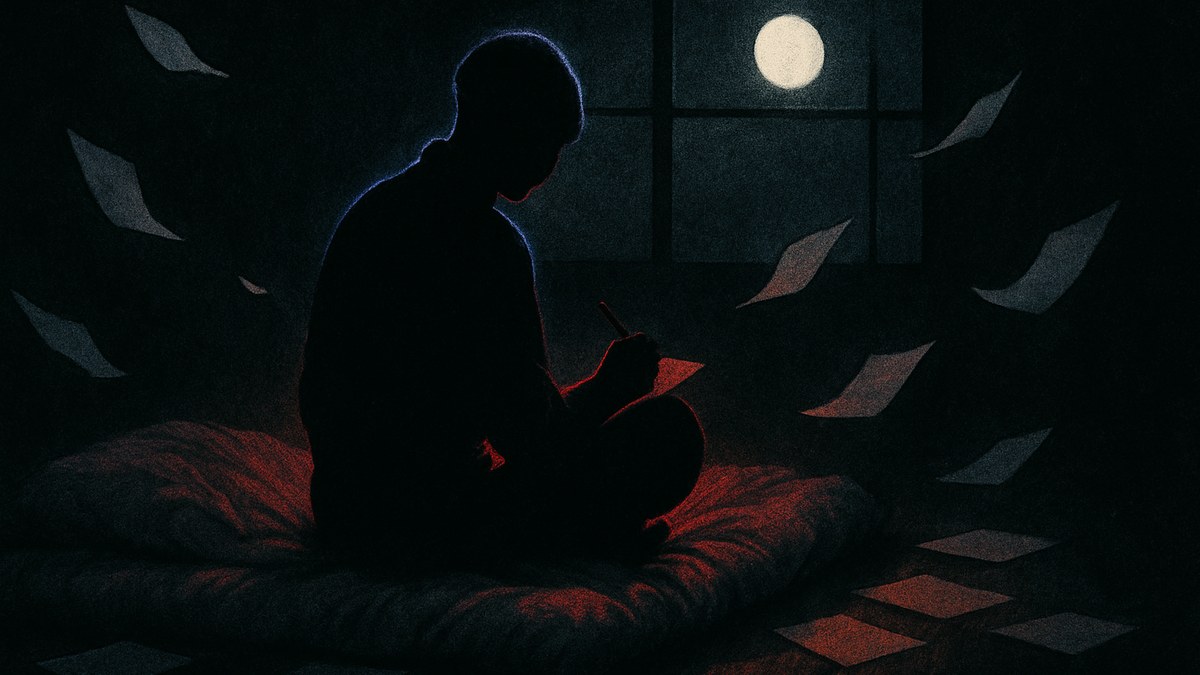
The instant you close your eyes in bed, the day comes flooding back. The comeback you never said. Tomorrow's deadline. The conversation that went wrong. The harder you try not to think, the faster your mind races, and sleep drifts further away.
The things that daytime busyness kept at the edge of your attention finally surface once everything goes quiet. This isn't weakness or being a worrier — it's how the brain naturally works. This article walks you through "bedtime journaling," a simple way to break that nighttime loop and drift off calmly.
Why thoughts won't stop at night
By day, we're chasing whatever is in front of us, and we set our feelings and worries aside for later. But at night, when the lights go out and stimulation drops, everything we set aside comes rushing back at once. Unprocessed events and nagging concerns start circling through your head.
Psychologists call this repeating of the same thoughts "rumination." It can feel like problem-solving, but in reality it's usually just running the same unanswerable question on a loop — and rather than resolving anything, it tends to deepen low moods and keep the brain wound up. You feel like you're "thinking it through," when you're really just circling the same spot.
On top of that, the brain is wired to hold on to what's unfinished more tightly than to what's done. A deadline, a message you haven't replied to — these open tasks keep their priority in memory until they're closed, and they resurface again and again in quiet moments. Much of that nighttime restlessness comes from this simple sense of "not finished yet."
The trouble is, this circling has no exit. No matter how much you think in bed, the deadline won't get done and the unsaid words can't be taken back. Yet your brain keeps flagging it as "unresolved" and refuses to lower its guard. The more you think, the more awake you become, and the further sleep recedes.
The key to stopping this loop is not to keep thinking, but to get it out — once — onto the page.
What bedtime journaling is
Bedtime journaling is the habit of writing out whatever is in your head onto paper or a screen before sleep, entrusting your thoughts to the page and letting them go. When you move circling thoughts into words outside yourself, your brain finds it easier to conclude, "this is recorded now — I don't need to hold it anymore."
The trick is not to try to make it neat. It doesn't have to read like a proper diary. Even a bulleted list of what's bothering you will lighten your head considerably. Leave the analysis and the reflection to tomorrow's you. Your only job tonight is to set it down and walk away.
This "get it all out at once" approach is often called a brain dump. To dump is simply to unload — you drop the pile of thoughts that has built up in your head all at once, without worrying about order or polish. A few lines, or even a string of words, is enough.
Four steps for a sleepless night
1. Write out what's in your head, exactly as it is
"Anxious about tomorrow's meeting." "I can't forgive how they said that." "Why only me." Jot down whatever surfaces, in any order. It doesn't need to be sentences — a string of words is enough. What matters is getting everything out of your head, without leaving anything behind.
2. Don't try to solve it
If you start figuring out "what should I do" while writing, your brain fires up again and you snap wide awake. You don't need solutions here. Leave anxiety as anxiety and frustration as frustration — just note it down and move on.
3. Hand tomorrow's problems over to tomorrow
Add a line like "I'll think about this in the morning," and your brain can let go with peace of mind. Simply writing down what you need to do releases the tension of "I have to remember this," making it easier for your attention to switch toward sleep.
4. When you're done, close it without re-reading
Once it's all out, quietly close it without re-reading. Looking back to reflect will only set your thoughts in motion again. Imagine leaving those thoughts right there where you set them down, and gently close your eyes. That alone changes how you wake the next morning.
Three things to avoid before bed
As you prepare to write and let go, there are a few habits worth avoiding. None of them are dramatic — a little awareness is all it takes to change them.
Scrolling your phone right up until you sleep
The light of a bright screen wakes the brain and pushes sleepiness away. Worse still, social media and news feed you a stream of fresh stimulation, planting new seeds of worry in a mind that was just starting to settle. If you use a screen to journal, dim it, and once you're done, close it and let go.
Caffeine late in the day
The caffeine in coffee, tea, and energy drinks lingers in your body far longer than most people assume. Have it in the late afternoon or evening, and you may still be wired at bedtime. If your sleep has felt shallow for days on end, simply easing off afternoon caffeine can make a difference.
Checking the clock over and over
"It's already 2 a.m. — only four hours left." Every glance at the time ratchets up the pressure, and that pressure wakes you further. On sleepless nights especially, the right move is to not look. Put the clock out of sight, or turn it face down.
Get the basics of sleep hygiene in place
Journaling works best when your daily rhythm is steady, and this takes nothing elaborate. Start by waking up at roughly the same time every day — keeping weekend lie-ins modest steadies your body clock. Getting sunlight in the morning helps sleepiness arrive that night. Keep the bedroom as dark and quiet as you can, and get into bed only once you feel drowsy. Just tending to these basics sharply cuts how often nighttime restlessness gets to run the show.
With the words of a "curse," you can vent honestly
Some routines have you list positive things or count your blessings before bed. But on a night when you're angry, or your chest is restless with worry, being told to "remember the good things" only makes it harder.
Noroi Nikki is an app for those nights. We built it as a place where you can let negative feelings out as "curses," exactly as they are — no need to dress them up. Saved journal text is not public to other users. Open it bedside, seal tonight's frustration inside, and close it. That alone makes your head a little quieter.
Don't carry your racing thoughts through the night. Put them into words and set them down. Let tonight's worry go while it's still tonight.
References
- James W. Pennebaker, Opening Up: The Healing Power of Expressing Emotions (Guilford Press, 1997). A foundational body of research on the effects of writing out emotions, known as expressive writing.
- Susan Nolen-Hoeksema, Women Who Think Too Much (Henry Holt, 2003). An accessible overview of the research on how rumination — replaying unanswerable thoughts — worsens mood and disrupts sleep.
FAQ
Frequently asked questions
Q.Why do my thoughts race the moment I try to sleep?
During the day, busyness pushes worries and unfinished business to the edge of your attention. At night, when things go quiet, those things finally surface and start circling. Unprocessed feelings and open loops keep your brain in a state of alertness, so it can't switch into rest mode. Writing them out helps break that circling.
Q.How long should bedtime journaling take?
About five minutes is plenty. There is no need to write a lot. Just jot down a few lines about what is on your mind, tomorrow's worries, or a phrase stuck in your head. What matters is not the length but moving the contents of your head onto paper or a screen.
Q.Won't writing make me more awake?
Trying to solve problems or reflect will wake your brain up and backfire. The key is to dump, not analyze. Write it, then close it without re-reading. Picture yourself setting the thoughts down and leaving them there, and your mind will actually settle.
Q.What if I still can't sleep after writing?
If you've been lying awake for 15 to 20 minutes, don't force it. Get out of bed, sit somewhere with the lights low, and stay calm until sleepiness returns, then go back to bed. It's counterintuitive, but this usually gets you to sleep faster and keeps your brain from learning to associate bed with lying awake.
Q.I've heard screens keep you awake — is it okay to journal in an app?
Avoid staring at a bright screen for long, but a few minutes at low brightness won't cause much harm. In fact, being able to open something bedside, dump quickly, and close it makes bedtime journaling far easier to keep up. In an app like Noroi Nikki, saved journal text is not public to other users. Check who can unlock your device before writing sensitive details.
About the author
Katsuki Mitsumori三森 捷暉
CEO, SURISUTA K.K. / Operator of Doya Marke AI
Runs Doya Marke AI, a suite of practical AI services spanning content, ads, sales and HR, and hosts the YouTube channel 'SaaS wa Shinimasshen.' Creator and developer of Noroi Nikki, an app for writing out and letting go of emotions.
This article explains folklore, language and culture. It is not medical, legal or religious advice. Traditions are introduced as culture, not as instructions to harm anyone. Claims without a source are marked as popular belief.
ZUKAN
Meet the yokai of this feeling



RELATED
Related reads
 Emotional care
Writing Out Your Anger Makes It Lighter — A Ritual for Letting Go of Emotions
Anger and frustration only grow heavier the longer you hold them in. Here is why writing works, backed by psychology, and a simple step-by-step way to set difficult feelings down.
 Emotional care
Racing Thoughts at Night That Won't Stop? A Way to Write and Empty Your Head to Sleep
The moment you lie down, the day's mistakes and tomorrow's worries flood in and you can't sleep. Why do thoughts race at night? Here's how to honor the bedtime thought loop instead of denying it — writing your head's contents onto paper, letting them go, and drifting off, little by little.
 Emotional care
Regret Keeping You Up at Night? Write Down the Past You Can't Redo and Set It Aside
The moment you lie down, that failure or that one thing you said comes back, and regret keeps you awake. Here's how to write the past you can't redo onto the page and set it down, on nights you keep replaying it.